
The short version
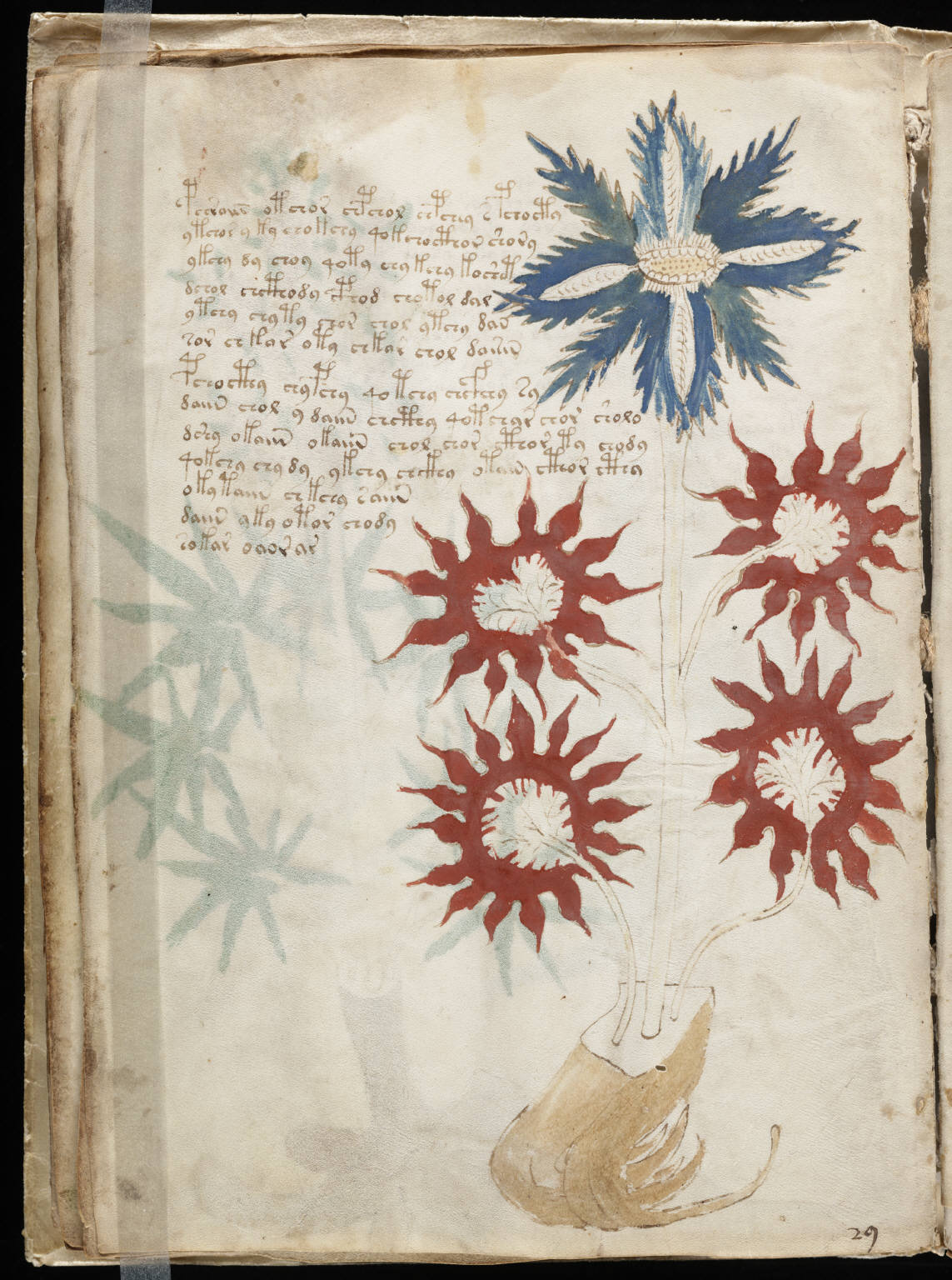
The Voynich manuscript is a small book of about 240 pages, filled with drawings of unknown plants, star charts and naked women bathing in strange pools, and around 38,000 words written in a script found nowhere else. It is named after Wilfrid Voynich, the book dealer who bought it in 1912, and is now kept at Yale University. Its parchment dates from the early 1400s. For more than a century, codebreakers, linguists and computer scientists have tried to read it, and every claimed solution has failed to convince other experts. Some think it hides a real language or a cipher. Others think it is a hoax: a book of meaningless text made to look mysterious, perhaps to sell to a wealthy collector.
What it is
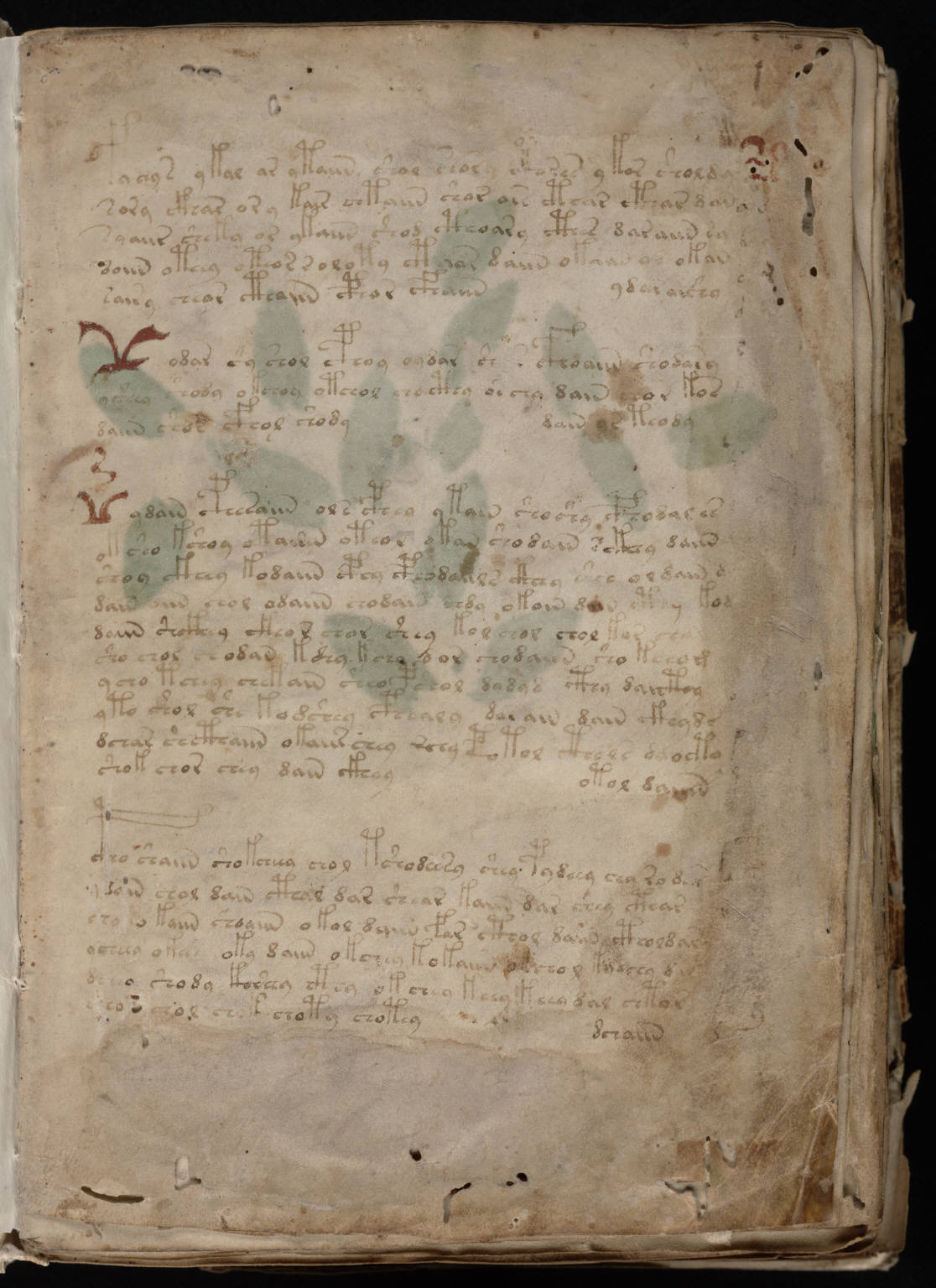
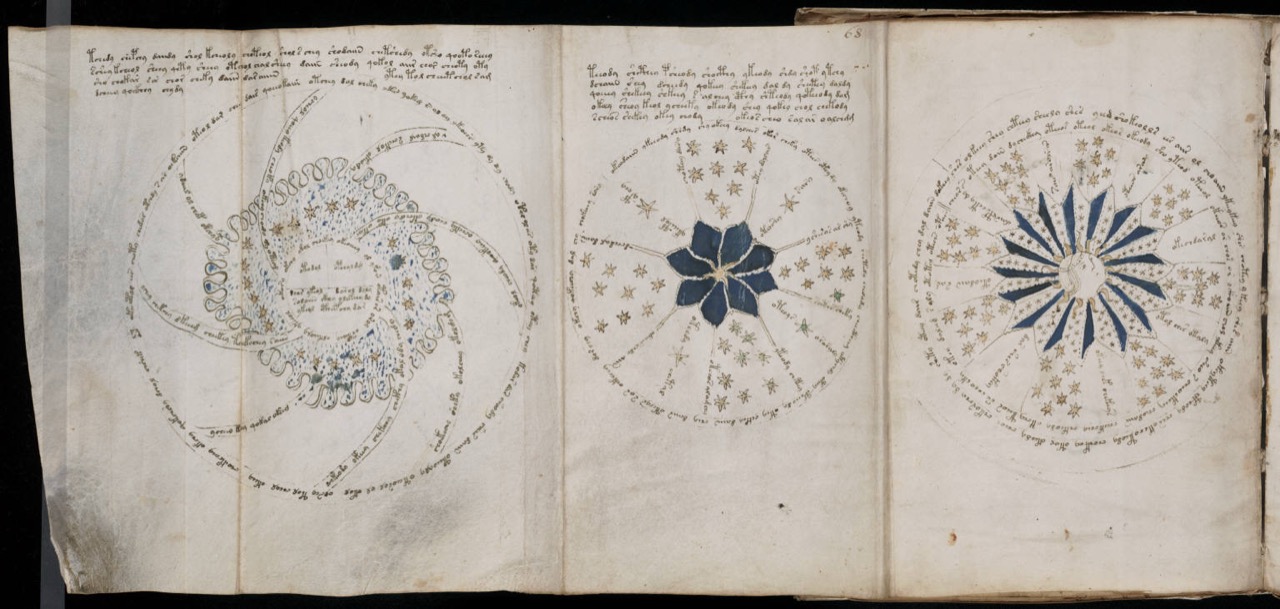
The manuscript is catalogued at Yale’s Beinecke Rare Book and Manuscript Library as MS 408, “Cipher Manuscript”. It is written on parchment and measures about 22.5 by 16 cm, with many fold-out pages. Judging by the pictures, it falls into sections: a large botanical section with drawings of more than 100 plants that have never been identified, an astronomical section with zodiac signs, a section of naked women in pools and tubes, a section of herbs and jars that looks like a pharmacy, and pages of continuous text marked with stars. Some leaves are missing. Researchers call the script “Voynichese”.
Where it came from
The earliest owners are known from a letter sent with the book. In it, Johannes Marcus Marci, a doctor in Prague, passed the manuscript to the Jesuit scholar Athanasius Kircher in Rome, in a letter dated 1665 or 1666. The letter reports that the Holy Roman Emperor Rudolf II had bought it for 600 gold ducats, believing it to be the work of Roger Bacon. A name erased from the first page, visible only under ultraviolet light, belongs to Jacobus Horcicky de Tepenecz, who died in 1622.
Wilfrid Voynich, a former Polish revolutionary who became a rare-book dealer, bought the manuscript in 1912 from a Jesuit college near Rome. After his widow’s death, a dealer bought it and gave it to Yale in 1969.
The date. In 2009 scientists at the University of Arizona carbon-dated samples of the parchment to between 1404 and 1438. That dates the animal skin, not the writing, but experts generally agree that the book is not a modern forgery.
The case for a hoax
Gordon Rugg, of Keele University, argued in 2004 that the text could be meaningless. He showed that text with many of the same features can be produced by hand, using a table of syllables and a card with holes cut in it, slid across the table to form words. In 2016 he showed that such text can even follow Zipf’s law, a statistical pattern found in real languages. Rugg points out that the manuscript does not contain a single crossed-out word, and that words at the start of lines are on average longer than those at the end, which “doesn’t make much sense” for a language. A book like this, he suggests, could have sold for something like a skilled workman’s annual salary.
Rugg is careful about his claims. “I’m not saying it definitely is a hoax; I can’t show that,” he said. “But what I can show is, you can produce text that has the quantitative and qualitative features of the Voynich Manuscript using low-tech, medieval technology.”
Suspects. Rugg notes that Edward Kelley, whom he calls one of history’s most colourful confidence tricksters, has long been suspected of making the book to sell to the emperor. Others have pointed at Voynich himself. The writer Simon Worrall, quoted by Smithsonian in 2014, said: “I believe the manuscript is a forgery by Wilfrid Voynich himself.”

The case against a hoax
The date. Critics of this idea point to the 17th-century letter kept with the book, which shows that it existed long before Voynich bought it, and to the carbon dating of the parchment to the early 1400s.
The statistics. Marcelo Montemurro, a physicist at the University of Manchester, analysed the patterns of words in the manuscript and found that they look like those of real language. “If it’s a hoax, it’s so well done that it mimics the statistics of actual language,” he said, which would be odd, since nobody at the time knew anything about the statistics of language. He argues that Rugg’s method cannot explain the full complexity of the text, and other critics consider it historically unlikely.
The effort. The Yale linguists Claire Bowern and Luke Lindemann think a medieval hoax unlikely because of the cost of making such a book and the number of people involved. The manuscript expert Lisa Fagin Davis concluded in 2020 that it was written by five different scribes. To The Atlantic, that suggested the work of a community rather than of a single con artist.
If not a hoax, then what?
There are several ideas, and none has been proven.
- A cipher. A known language encrypted with a code. But according to Bowern, no known cipher, certainly none from the early 1400s, could produce the text’s oddly repetitive letter sequences together with its language-like patterns.
- A lost or unknown language, written in an invented script.
- An artificial language. William Friedman, who broke Japan’s “Purple” cipher in the Second World War, tried and failed to read the manuscript. He came to think it was an early attempt to construct an artificial language.

The solutions that weren’t
- In the 1920s William Romaine Newbold, a philosophy professor at the University of Pennsylvania, claimed that tiny marks in the script were Greek shorthand that proved Roger Bacon wrote it.
- In 2018 computer scientists at the University of Alberta used artificial intelligence and suggested the text might be Hebrew with scrambled letters, but they could not say whether the words made sense together.
- Around the same time, Ahmet Ardıç, an electrical engineer, and his sons claimed it was written in an early form of Turkish.
- In 2019 a researcher at the University of Bristol published a paper claiming it was written in a “proto-Romance” language. After other scholars criticised the work, the university removed its press release.
Recent research
In 2024 Davis reported that multispectral images of the first page revealed hidden columns of letters, apparently added by Marci, who owned the book in the 1660s, perhaps as an early attempt to decode it. In January 2026 the science journalist Michael Greshko published a cipher that can turn Latin and Italian into text that looks like Voynichese, while stressing that it cannot be exactly how the manuscript was made. In October 2026 Davis and Colin Layfield of the University of Malta argued that the pages were meant to be loose sheets and have been bound in the wrong order.
The latest research has not brought a translation. Layfield says artificial intelligence cannot do much either, because the manuscript contains too few words to train on.
What is still argued about
- Whether the text has any meaning at all.
- If it does, whether it is a cipher, a lost language or an invented one.
- Who made it, and why.
No poll appears to have asked how many people think the manuscript is a hoax.
Sources
- Beinecke Rare Book and Manuscript Library, Yale University, catalogue entry for Beinecke MS 408
- René Zandbergen, “Radio-carbon dating”, voynich.nu
- Medievalists.net, “Mysterious Voynich Manuscript dates back to the 15th century” (2011)
- Live Science, “Lost Language, Code or Hoax? Why the Voynich Manuscript Still Stumps Experts” (2017)
- Live Science, “Undeciphered Voynich manuscript may have been bound out of order, study finds” (2026)
- Archaeology Magazine, “Voynich manuscript was bound in the wrong order, new study finds” (2026)
- The Atlantic, Ariel Sabar, “Will the Mystery of the Voynich Manuscript Ever Be Solved?” (2024)
- The Art Newspaper, “Voynich manuscript scans reveal early decoding attempt” (2024)
- The Art Newspaper, “Can a new cipher help to explain the mysterious Voynich Manuscript?” (2026)
- Keele University, Gordon Rugg, “Neither researchers nor the media can put down the world’s most mysterious book – and it’s a problem for science” (2019)
- Scientific American, Gordon Rugg, “The Mystery of the Voynich Manuscript” (2004)
- ScienceAlert, “This researcher says he has evidence that world’s most mysterious book is an elaborate hoax” (2016)
- Smithsonian Magazine, “Is One of the Weirdest Books on the Planet Actually a Hoax?” (2014)
- Discover Magazine, “Was the World’s Most Mysterious Manuscript From the Middle Ages a Hoax?” (2024)
- Mental Floss, “The Most Secretive Book in History” (2022)
- Gizmodo, “Sorry, It Looks Like a Researcher Didn’t Just Crack the Voynich Manuscript” (2019)
- Open Culture, “Has the Voynich Manuscript Finally Been Decoded?” (2019)
- University of Alberta, “Using AI to uncover ancient mysteries” (2018)