
The short version
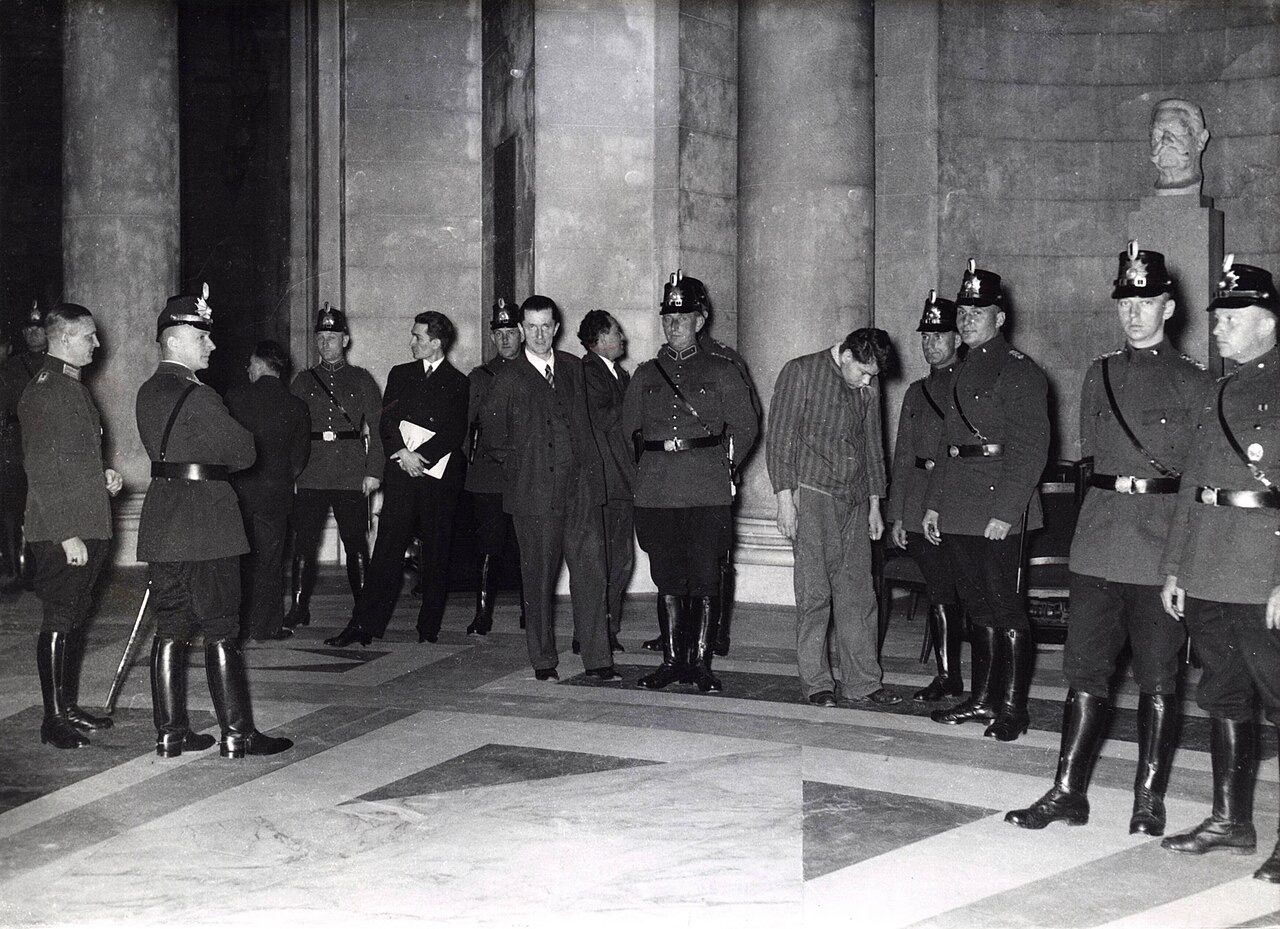
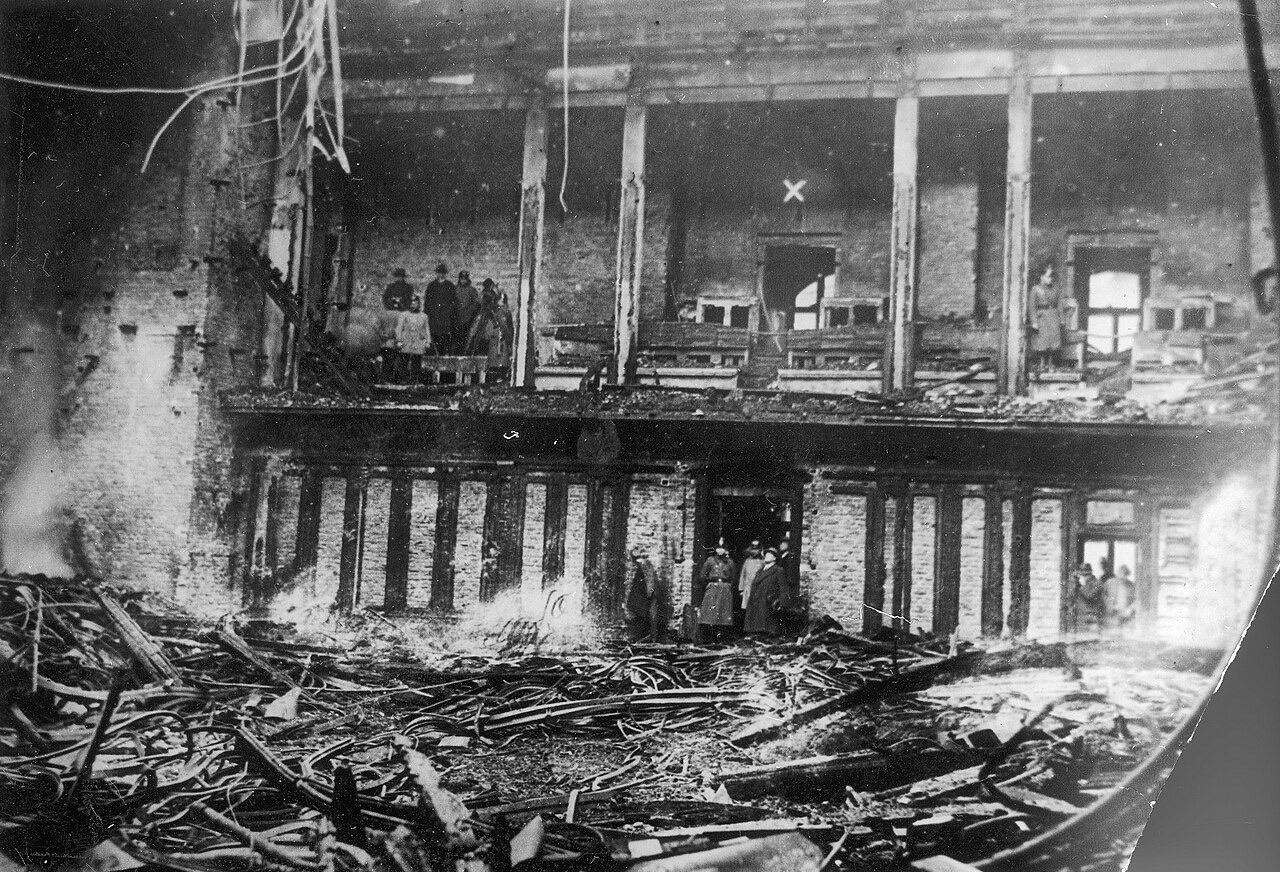
Shortly after 9 pm on 27 February 1933, the Reichstag, the German parliament building in Berlin, began to burn. Marinus van der Lubbe, a 24-year-old Dutch left-wing radical, was arrested inside and confessed at once, saying he had acted alone. The Nazi government, in power for four weeks, called the fire the start of a communist uprising. The next day a decree suspended basic rights, and it stayed in force until 1945. Van der Lubbe was sentenced to death and executed. Since 1945 hardly anyone has believed that the communists did it. But the question of who did has never been settled. Some historians say van der Lubbe acted alone. Others say Nazi stormtroopers set the fire, or helped him. The poll lets readers choose.
The night of the fire
The fire alarm sounded shortly after 9 pm. Firefighters raised the highest alarm level at 9.42 pm, and the fire was under control within a few hours. The wood-panelled debating chamber burned out completely. The rest of the building was largely spared. The fire had been set in several places.
Van der Lubbe was arrested inside the burning building. Born in Leiden in 1909, he had trained as a bricklayer until an accident at work injured his eyes. He had been a member of the Dutch Communist Party until 1931, then moved towards anarchism and council communism. Two days before the fire, he had tried to set fire to three public buildings in Berlin. He told police he had used firelighters and burning rags, and that he wanted to call German workers to resist the Nazis.
The Nazi leadership immediately blamed the Communist Party and called the fire an attempted uprising. Opponents of the regime accused the Nazis of setting it themselves. Historians today regard the claim of a communist plot as refuted.
What the fire made possible
On 28 February 1933 President Paul von Hindenburg signed a “Decree for the Protection of People and State”, co-signed by Hitler. It suspended rights to personal liberty, free speech, a free press, assembly and association, and the privacy of post and telephone. It also introduced the death penalty for arson and high treason. Police and the Nazi stormtroopers, the SA, arrested thousands of people, mostly communists. The decree was never lifted. The political scientist Ernst Fraenkel later called it the “constitutional charter” of Hitler’s Reich.
Elections followed on 5 March, in which the Nazi party won 43.9% of the vote. In late March the Reichstag passed the Enabling Act, voting away its own power.
The trial
Van der Lubbe went on trial at the Reich Court in Leipzig from September to December 1933 with four communists: Ernst Torgler, leader of the Communist Party group in the Reichstag, and three Bulgarians, Georgi Dimitrov, Blagoi Popov and Vasil Tanev. Hermann Göring and Joseph Goebbels gave evidence. Dimitrov called the fire an anti-communist provocation, and in a famous exchange Göring lost his temper.
On 23 December 1933 the court sentenced van der Lubbe to death for high treason and arson. The other four were acquitted for lack of evidence. Because the death penalty for arson had been introduced after the fire, it was applied retroactively through a law passed in March 1933. Van der Lubbe was beheaded on 10 January 1934, three days before his 25th birthday.
Meanwhile, the exiled communist Willi Münzenberg had published the Brown Book, which accused the Nazis of setting the fire. A “counter-trial” held in London found the Nazis guilty and described van der Lubbe as their tool.
The arguments, point by point
He acted alone
Those who believe it say: van der Lubbe was caught at the scene, confessed immediately and repeatedly said he acted alone. In 1959 Fritz Tobias, a senior official in one of West Germany’s domestic intelligence services, argued in a series of articles in Der Spiegel that he was the only arsonist. In 1964 the historian Hans Mommsen backed him, arguing that the chamber’s air supply and high ceiling worked like a chimney, so one person could have destroyed it quickly. By the mid-1960s, most historians of Nazi Germany agreed. In 2014 the British historian Richard J. Evans wrote that van der Lubbe’s “confession remains a compelling piece of evidence”.
The response: experts at the 1933 trial already doubted that one man could have done it alone, though the Nazis used that to claim a communist plot. The American historian Benjamin Carter Hett, a former trial lawyer, argued in his 2014 book Burning the Reichstag that the chamber could not have been set alight in the time van der Lubbe had without an accelerant. “There is no way he could have set fire to the plenary chamber within the 15 to 20 minutes at his disposal,” he told The Guardian. Another researcher, Hersch Fischler, calculated that van der Lubbe had at most 11 or 12 minutes.
The Nazis did it
Those who believe it say: the Nazis gained the most from the fire. Hett concludes that “plausible circumstantial evidence points to a small group of Berlin SA men as the real culprits”. He argues that the Gestapo officers who led the investigation, several of whom later faced war-crimes or denazification cases, built the lone-arsonist story after 1945, and that Tobias relied on them. At Nuremberg in 1946, Hans Bernd Gisevius, a Gestapo official in 1933 who later joined the resistance, testified that “it was Goebbels who first thought of setting the Reichstag on fire” and that SA men carried it out. In 2019 a sworn statement from 1955 by a former SA man, Hans-Martin Lennings, was found in a Hanover court archive. He said he had driven van der Lubbe to the Reichstag and that the fire was already burning when they arrived.
The response: Evans called Hett’s book “the work of a prosecuting attorney rather than of a balanced historian”. Gisevius’s credibility has been disputed. Lennings died in 1962, and his account contradicts many details in the investigation files and van der Lubbe’s own statements. At Nuremberg, the prosecution read Göring a statement from General Franz Halder, who said Göring had boasted at a lunch in 1942: “The only one who really knows the Reichstag is I, for I set fire to it.” Göring called it “utter nonsense” and denied it.

What happened later
Van der Lubbe’s family tried for decades to clear his name. In December 1980 a West Berlin court overturned the 1933 verdict, but an appeals court reversed that ruling in April 1981. In December 2007 federal prosecutors found that the verdict had been annulled under a 1998 law that cancelled unjust Nazi-era judgments. The decision was announced in January 2008. It was symbolic and did not rule on whether he set the fire. In 2023 his remains in Leipzig were exhumed. Toxicologists found no evidence that he had been drugged, though they said that after so many years this could not be fully ruled out.
What is still argued about
- Whether one man could have set the chamber alight so quickly.
- Whether the Gestapo investigators, and later Tobias, shaped the lone-arsonist story.
- If Nazis were involved, whether it was a small SA group acting on its own or a plan from the top.
Most historians agree that van der Lubbe was involved. Whether he acted alone is still debated, and the multiple-arsonist view has slowly been gaining ground again. What is not disputed is that the Nazis used the fire to tear up civil rights. No poll appears to have asked people who they think set the fire.
Sources
- Deutscher Bundestag, “27. Februar 1933: Reichstagsbrand in Berlin” (2023)
- Bundeszentrale für politische Bildung, “Reichstagsbrand – auf dem Weg in die Diktatur”
- Bundesarchiv, “23. Dezember 1933: Urteil des Reichsgerichts im Reichstagsbrandprozess”
- Deutsches Historisches Museum, LeMO biography of Marinus van der Lubbe
- Jüdische Allgemeine, “Als der Reichstag in Flammen aufging” (2023)
- US Holocaust Memorial Museum, “Reichstag Fire Decree”
- Benjamin Carter Hett, “What Really Caused the Reichstag Fire”, History News Network (2014)
- Washington Independent Review of Books, review of Burning the Reichstag (2014)
- Richard J. Evans, “The Conspiracists”, London Review of Books (2014)
- HistoryNet, “They Say He Burned Down the Reichstag. But Was He Drugged Into Confessing?” (2023)
- taz, “Ein Historikerstreit ist wieder offen” (1998)
- Avalon Project, Nuremberg trial proceedings, 18 March 1946
- Avalon Project, Nuremberg trial proceedings, 25 April 1946
- Jüdische Allgemeine / dpa, on the Lennings statement (2019)
- The Local / AFP, “Ex-Nazi’s testimony casts fresh doubt on 1933 Reichstag blaze” (2019)
- Christian Science Monitor, on the 1980 ruling (1981)
- Christian Science Monitor, “Reichstag verdict reversal reversed in W. Berlin” (1981)
- Jüdische Allgemeine, “Reichstag, Rauch und Revision” (2008)
- Taipei Times / The Guardian, “Reichstag arsonist, beheaded in 1934, receives pardon” (2008)
- Leipziger Internet Zeitung, on the 2023 exhumation (2023)