
The short version
On the night of 15 November 1966 two young couples driving near Point Pleasant, West Virginia, said a winged, man-shaped creature with glowing red eyes followed their car. The local paper reported it the next day, and within weeks dozens of people had reported sightings. The press called it the “Mothman”. A wildlife biologist said the witnesses had probably seen a sandhill crane, and a sceptic investigator later suggested an owl. In 1975 the writer John Keel linked the sightings to UFO reports and to the collapse of the Silver Bridge in 1967. A 2002 Hollywood film, a statue and a yearly festival have since made the Mothman one of America’s best-known monsters.
The night of 15 November 1966
Roger and Linda Scarberry and Steve and Mary Mallette were driving around midnight through the “TNT Area”, the overgrown remains of a Second World War munitions plant north of Point Pleasant. They said a figure shaped like a man, about six to seven feet tall, with large wings and two bright red eyes, appeared in their headlights. It seemed to have no clear head or neck. As they fled towards town, they said, it followed them. “We were going between 100 and 105 mph down that straight stretch and that thing was just gliding back and forth over the back end of the car,” Linda Scarberry later recalled.
They went to the police, and on 16 November the Point Pleasant Register reported that two couples had “encountered a man-sized, bird-like creature”. Mary Hyre, a local reporter for The Athens Messenger, an Ohio paper, wrote ten columns about the “Mason County monster” before the end of the year. Sightseers drove the dusty roads of the TNT Area every night in the hope of seeing it. The nickname “Mothman” came from the press and is generally said to be a play on Batman, whose television series was popular at the time.
More reports followed. On 18 November two volunteer firemen said they had seen a very large bird with large red eyes. A group of gravediggers near Clendenin, about 50 miles away, said that on 12 November something like a “brown human being” had flown over their heads, though they only reported it after the couples’ story came out. By some counts, about a hundred people reported sightings in the area over the next 13 months.
The bird explanations
On 1 December 1966 the Associated Press reported the view of Robert L. Smith, a wildlife biologist at West Virginia University. He said the descriptions fitted a sandhill crane, a bird that stands almost as tall as a man and has a wingspan of more than seven feet, which had probably strayed from its migration route. The “red eyes”, he said, could be the patches of bare reddish skin around a crane’s eyes. Critics of this idea note that the species is not native to West Virginia and that the witnesses described a creature without a neck. The county sheriff thought it was probably a heron.
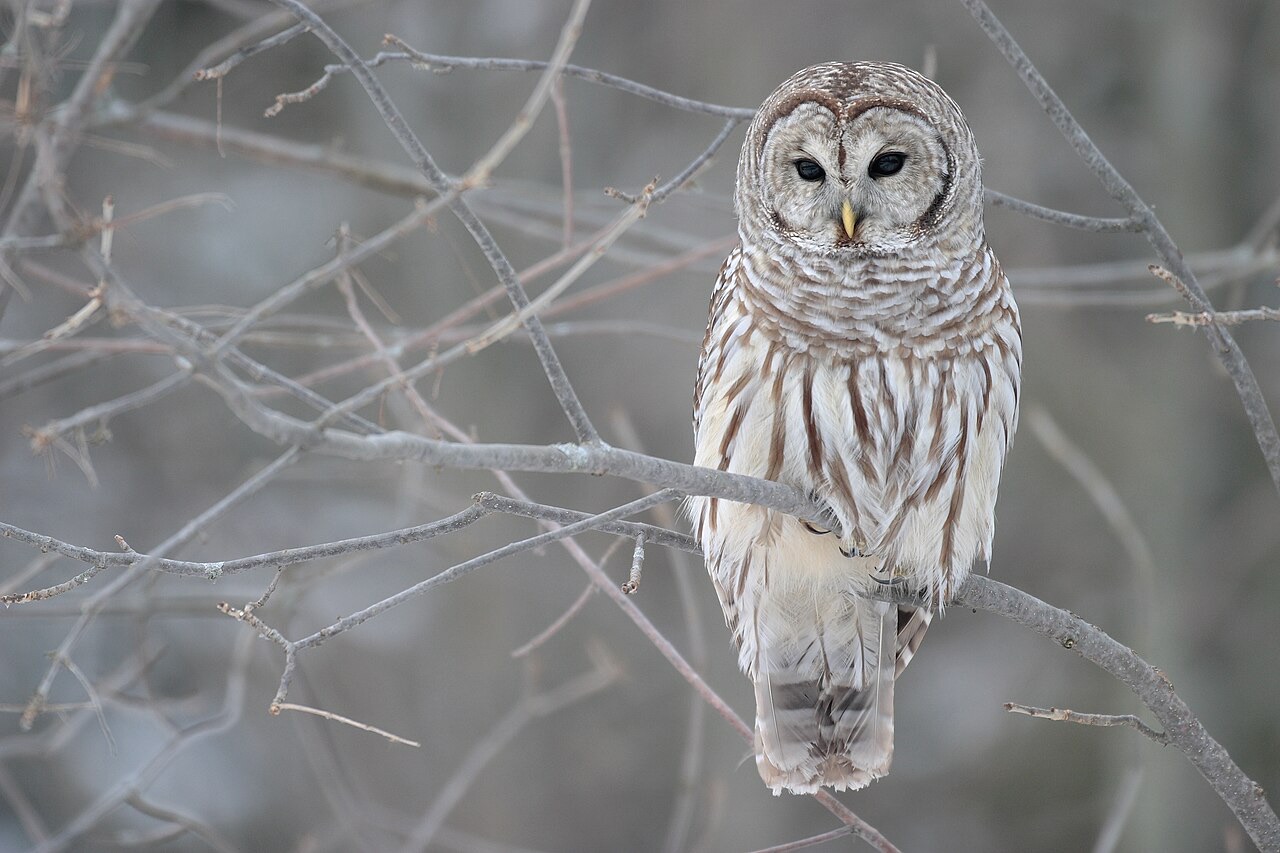
Joe Nickell, an investigator with the Committee for Skeptical Inquiry, argues that the creature was an owl. He first thought of a barn owl, but now favours the barred owl, which lives in the area and has a strong crimson eyeshine. He points out that if you misjudge how far away a bird is, you misjudge its size by the same proportion.
The Silver Bridge
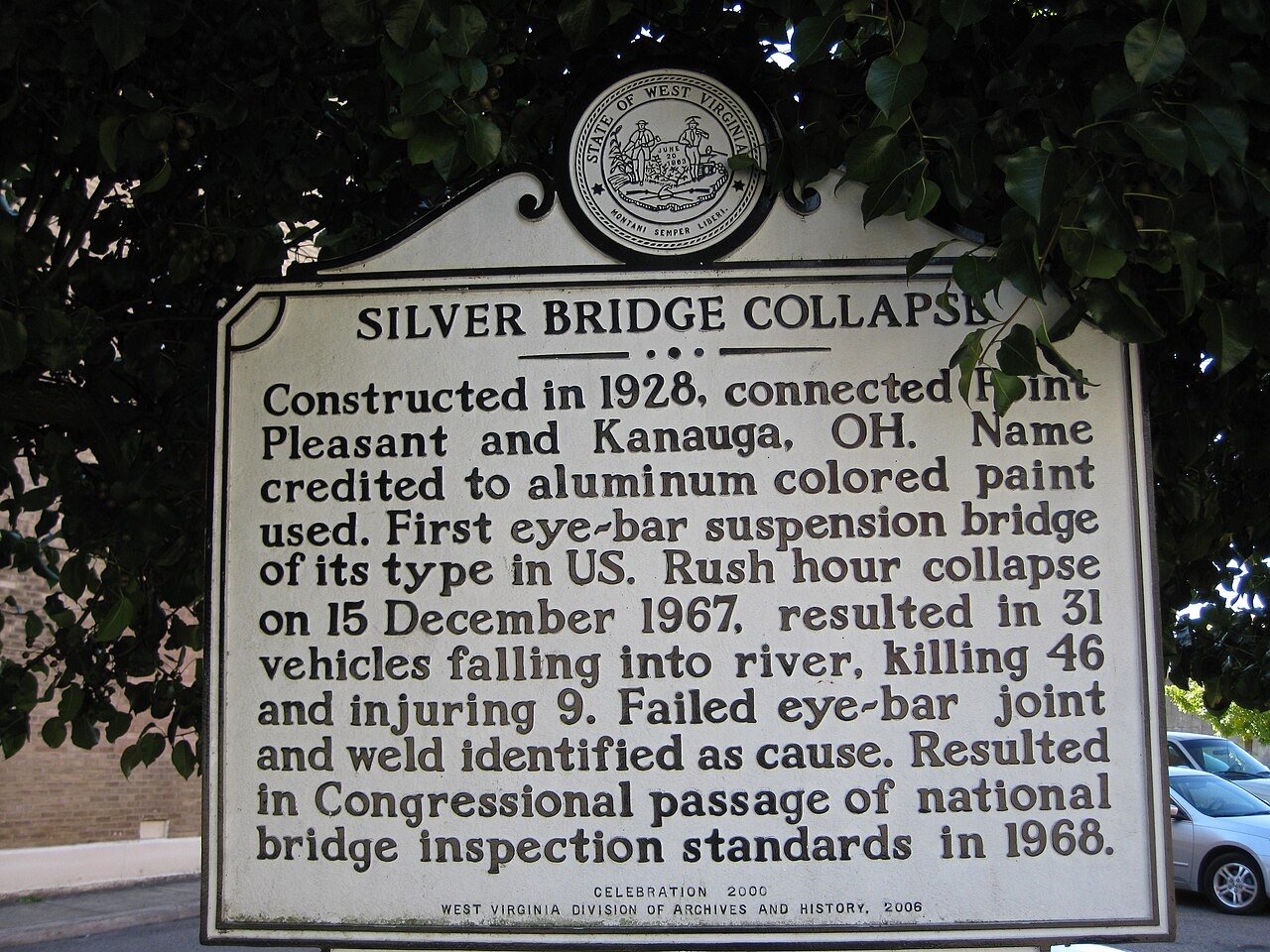
At about 5 p.m. on 15 December 1967, at rush hour, the Silver Bridge linking Point Pleasant with Ohio collapsed. More than 30 vehicles fell with it, and 46 people died. In 1971 the National Transportation Safety Board found that a single link in the bridge’s eyebar chain had fractured. A tiny flaw had grown over the bridge’s 40-year life through stress corrosion and corrosion fatigue, in a place that could not be seen by inspection. The disaster led to the first national bridge inspection standards in the United States.
Rumours spread that the Mothman had been seen near the bridge before it fell. Some locals wondered whether the creature had been a warning, or even the cause. After the collapse, reported sightings largely stopped.
John Keel and the film
John A. Keel, an American writer on UFOs and the paranormal, investigated the sightings in 1966 and 1967 and worked with Mary Hyre. In 1975 he published The Mothman Prophecies, dedicated to her. The book argued that the Mothman sightings, local UFO reports and the bridge collapse were connected phenomena. It was loosely adapted into a 2002 film starring Richard Gere and Laura Linney, which ends with the collapse.

The arguments, point by point
The witnesses
Those who believe it say: the first witnesses went straight to the police, and decades later Roger Scarberry gave the Mothman Museum an interview telling the same story. Others who reported sightings included teachers, police officers and pilots. “Believe me if you ever saw it, you’d be a believer,” one witness told the press in 1966.
The response: Nickell argues that anyone who misjudges how far away a bird is will misjudge its size as well. Audubon magazine describes the wave of sightings that followed as “some honest, some the product of likely hoaxes”.
Not a bird
Those who believe it say: the witnesses described something six to seven feet tall that kept up with a car at 100 mph and had no clear head, which does not sound like any bird. Believers have described the Mothman as an alien, a prophet of doom or a being from another dimension, and many connect it with the UFO sightings and “men in black” reported in the area at the time.
The response: the barred owl Nickell suggests is only 17 to 20 inches long, but he argues that its size is easily misjudged and that its crimson eyeshine matches the red eyes. Smith pointed to the crane’s size and red eye patches.
The bridge
Those who believe it say: the creature appeared in the months before a deadly disaster in the same town, and was rumoured to have been seen near the bridge.
The response: the collapse came more than a year after the first sightings. Investigators found a physical cause in the steel. A folklorist at the Library of Congress has suggested that the idea of a warning appeals because it gives people a sense of power over the unthinkable.
What is still argued about
- What the couples saw on 15 November 1966.
- Whether later reports, such as a wave of 55 sightings of a winged humanoid around Chicago in 2017, have anything to do with the original.
No poll appears to have asked about the Mothman specifically. Point Pleasant, a town of fewer than 5,000 people, now holds a three-day Mothman Festival each September that draws about 20,000 visitors. A 12-foot stainless-steel statue of the creature has stood in the town centre since 2003, and a Mothman Museum opened in 2005.
Sources
- NPR, “Mothman Festival draws visitors to Point Pleasant West Virginia” (2025)
- West Virginia Public Broadcasting, “From Mothman To The Silver Bridge: 13 Months In The Life Of A Local Journalist” (2025)
- Audubon, “Is the Mothman of West Virginia an Owl?” (2018)
- Snopes, “‘Mothman’ Returns to Point Pleasant, West Virginia?” (2016), quoting AP reports from 1966
- EBSCO Research Starters, “Mothman”
- Encyclopedia of Occultism and Parapsychology, “Mothman”, via Encyclopedia.com
- Parkersburg News and Sentinel, “Ghost Stories: The Mothman is W.Va.’s winged wonder” (2018)
- West Virginia Explorer, “Did legendary Mothman first appear near Elk River Trail?”
- WCHS/ABC6, “Amazing America 250: How the legend of West Virginia’s Mothman has grown over the years” (2026)
- West Virginia Department of Transportation, “Silver Bridge”
- e-WV: The West Virginia Encyclopedia, “Silver Bridge Collapse”
- NPR, “Earlier Disaster Led to Focus on Bridge Safety” (2007)
- AP obituary of John A. Keel, Philadelphia Inquirer (2009)
- WBEZ Curious City, “The Case Of The Chicago Mothman” (2019)
- Vice, “People Keep Seeing the Mothman in Chicago” (2018)