
The short version
Between July 1969 and December 1972, NASA says it landed six crews on the Moon and brought all of them home. The hoax theory says some or all of that was filmed on Earth. Belief in it has never been a majority view, but it has never gone away either.
What the theory says
The core claim is that the United States could not reach the Moon by the end of the 1960s, as President Kennedy had promised, and faked it rather than lose the space race to the Soviet Union. In this telling, the television pictures, photographs and Moon rocks were produced on Earth, and the astronauts either stayed in Earth orbit or never left the ground.
Where it came from
Doubts appeared almost as soon as the missions ended, but the theory took its modern shape in 1976, when Bill Kaysing self-published We Never Went to the Moon. Kaysing had worked in technical publications for Rocketdyne, a company that built Apollo engines, and argued that the odds of a successful landing were too low for it to have been real.
Two years later, the Hollywood film Capricorn One showed NASA faking a Mars mission in a studio. It was fiction, but it gave the idea a picture. In 2001 a Fox television special, Conspiracy Theory: Did We Land on the Moon?, brought the claims to a new generation, and the internet has kept them in circulation since.
Three versions of the theory
Nothing happened. No crewed mission ever left Earth orbit. All six landings were staged.
Real trip, fake footage. Astronauts did reach the Moon, but the pictures shown to the public were made on Earth, either because the real ones failed or to hide something found there.
Only the first was faked. Apollo 11 was staged to meet the 1969 deadline, and later missions landed for real once the technology caught up.
A popular side story adds that director Stanley Kubrick, fresh from 2001: A Space Odyssey, shot the footage.
The arguments, claim by claim
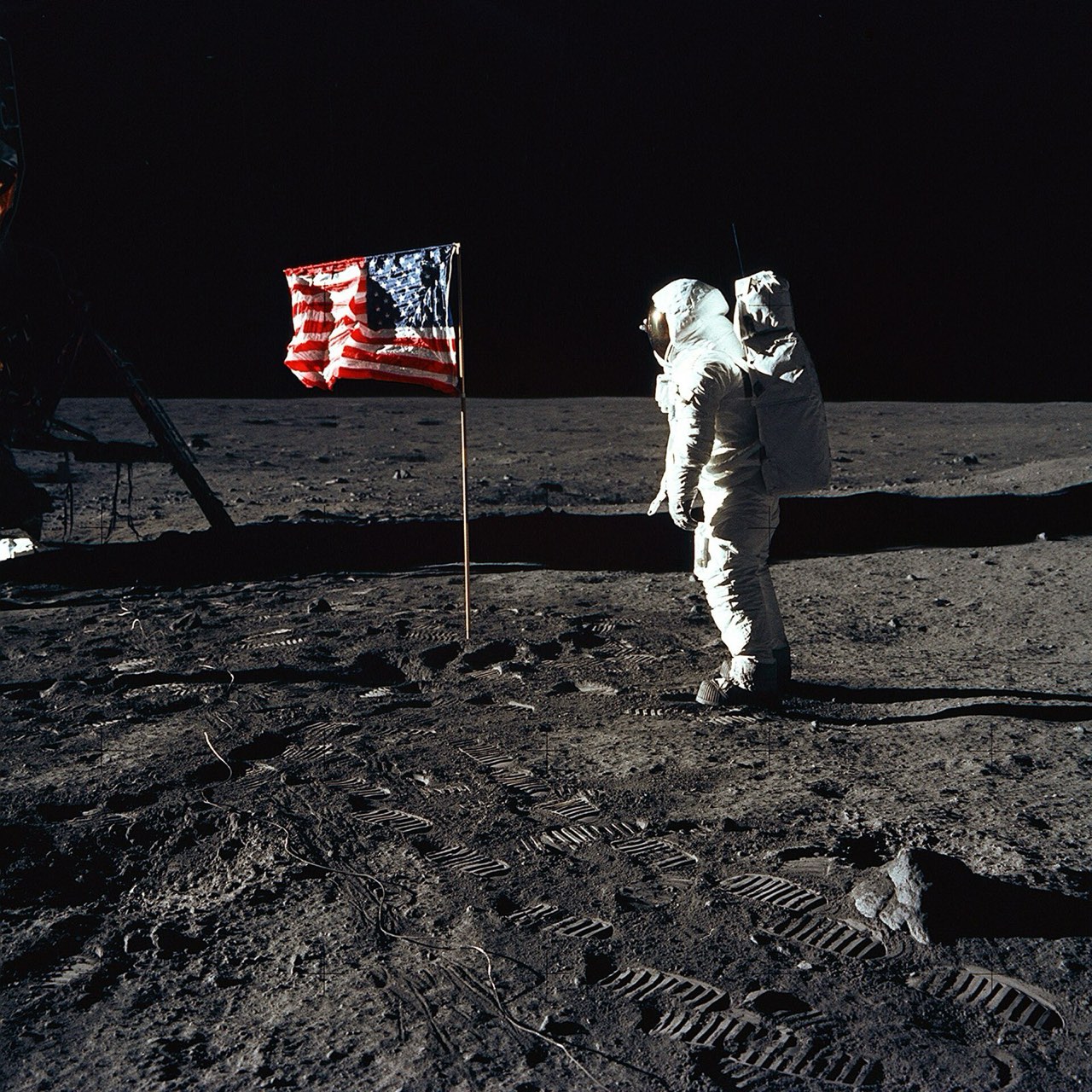
The flag waves, but there is no air
Believers say: a flag can only flutter in wind, so the scene was filmed on Earth.
The response: the flag hung from a horizontal rod along its top edge so it would stay spread out. It moves in the footage when astronauts twist the pole into the ground, and with no air to damp the motion it keeps swinging longer than it would on Earth. When nobody touches it, it is still.
There are no stars in the photographs
Believers say: a studio could not reproduce the real star field, so NASA left the sky black.
The response: the landings took place in lunar daytime. Cameras were set with fast shutter speeds for brightly lit ground and white spacesuits, which is too short an exposure to register faint stars. The same thing happens in photos taken from orbit today.
Shadows fall in different directions
Believers say: with the Sun as the only light, all shadows should be parallel. Diverging shadows mean several studio lamps.
The response: shadows cast over uneven ground follow the slope they fall on, and wide-angle lenses exaggerate perspective. Several lamps would also give each object several shadows, which the photos do not show.
Radiation would have killed the crew
Believers say: nobody could survive passing through the Van Allen radiation belts.
The response: the spacecraft crossed the belts in a matter of hours on a path that avoided the most intense regions. Crew dosimeters recorded doses well below levels that cause radiation sickness.
There is no blast crater under the lander
Believers say: a rocket engine should have dug a pit.
The response: the descent engine was throttled down for landing and its exhaust spread out in the vacuum. Photos show dust scoured away beneath the engine bell, down to firmer ground.
The technology did not exist
Believers say: 1960s computers were too primitive, and it is suspicious that nobody has been back.
The response: the guidance computer was simple, but navigation relied heavily on ground tracking and calculation on Earth. The programme ended for cost and political reasons after Apollo 17, and the Saturn V production line was closed.
What the record shows
Samples. The missions returned 382 kg of rock and soil. Samples have been lent to laboratories in many countries for decades, and their age and chemistry differ from Earth rocks and from meteorites.
Reflectors. Apollo 11, 14 and 15 left laser reflectors on the surface. Observatories on Earth still bounce lasers off them to measure the distance to the Moon.
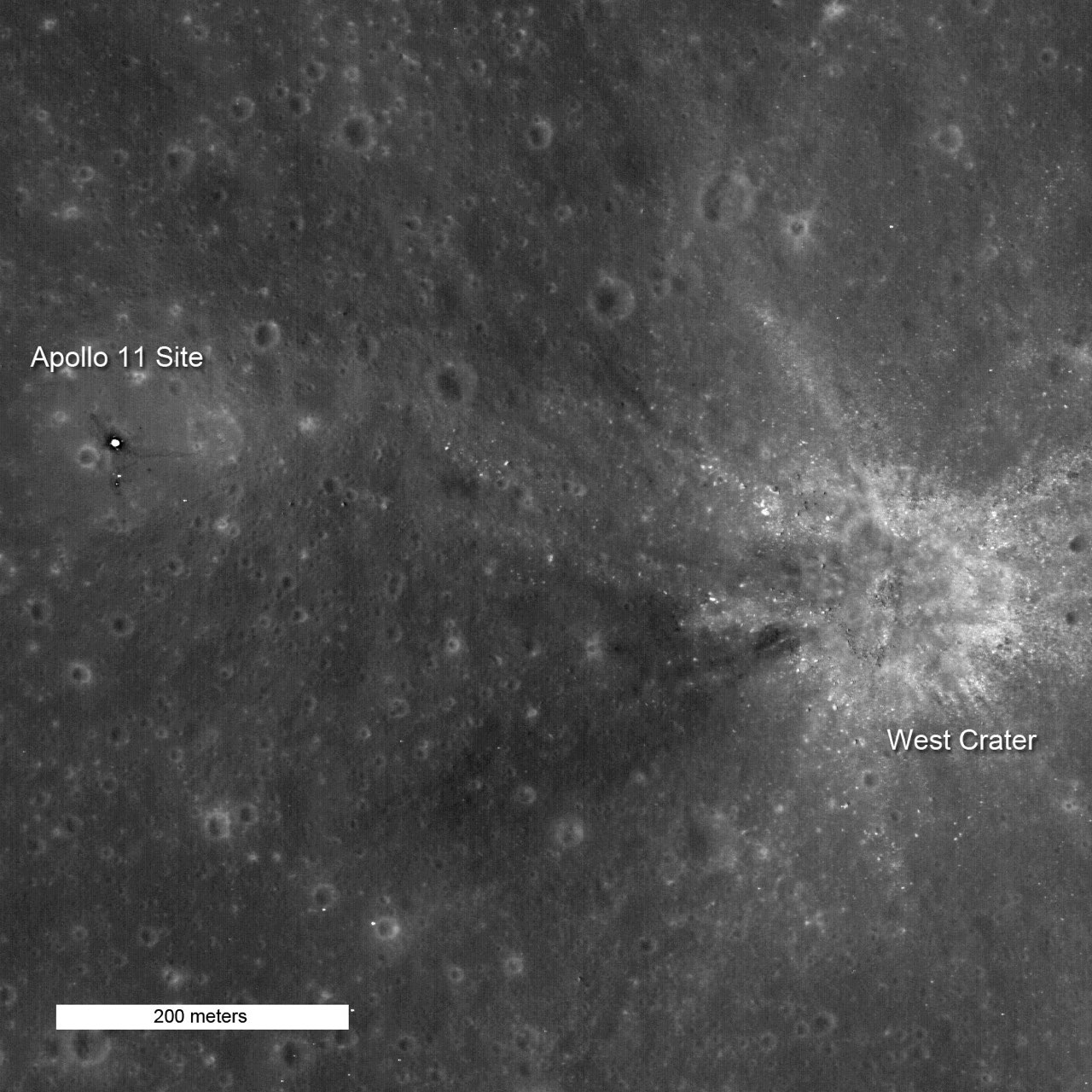
Orbital photographs. Since 2009, NASA’s Lunar Reconnaissance Orbiter has photographed the landing sites. The images show descent stages, instruments and the trails left by astronauts and rovers, in the places the mission records say they should be.
Independent tracking. The missions were followed by observatories and radio operators outside NASA, and by the Soviet Union, which had every reason to expose a fake and never claimed one.
Scale. Roughly 400,000 people worked on Apollo. Believers reply that most of them only saw a small part and need not have known.

What is still argued about
NASA acknowledged in 2009 that the original high-quality tapes of the Apollo 11 broadcast had most likely been erased and reused during a tape shortage. Sceptics find that hard to accept for the most famous recording in history. The agency calls it a record-keeping failure, and the broadcast survives in converted copies.
Believers also point out that every piece of orbital evidence comes from NASA itself, although spacecraft from other countries have since imaged signs of the sites too.
How many people believe it
In a 1999 Gallup poll, 6% of Americans said the landing was faked and 89% said it was not. Later surveys have found higher numbers, especially among younger adults. A 2019 YouGov poll found that 16% of Britons thought the landing was probably or definitely staged.
Sources
- Gallup, “Did Men Really Land on the Moon?” (1999 poll)
- YouGov, Moon landing 50-year anniversary poll (2019)
- NASA, Apollo Lunar Surface Journal (mission transcripts and photography)
- NASA Goddard / Arizona State University, Lunar Reconnaissance Orbiter Camera, Apollo landing site images
- NASA, “The Apollo 11 Telemetry Data Recordings: A Final Report” (2009)
- Bill Kaysing, We Never Went to the Moon (1976)