
The short version
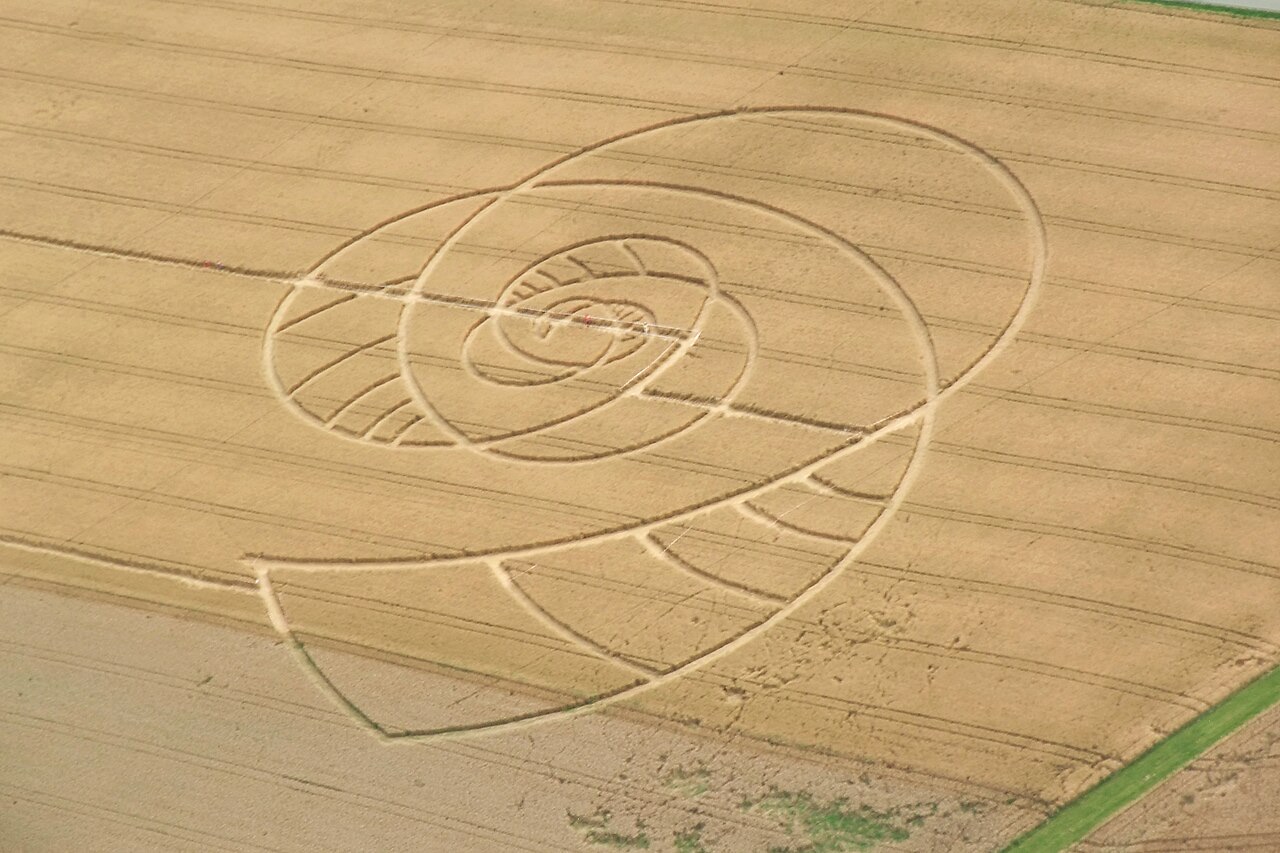
Nobody disputes that people make crop circles. Artists do it for television cameras and for paying clients, and one man has been fined for it. The argument is about whether people make all of them. Believers point to formations with hundreds of elements that seem to appear within hours, to changes in the plants, and to the fact that the makers of the most famous designs have never been identified. Sceptics answer that no circle has ever been recorded forming by itself, and that the patterns appear where people can easily reach them.
How it started
Old stories. An English pamphlet of 1678, “The Mowing-Devil”, tells of a farmer whose oats were found cut in round circles overnight, supposedly by the devil. In 1880 a letter in the journal Nature described a wheat field in which storms had left “circular spots”. In 1966 a farmer near Tully in Queensland, Australia, reported a flying saucer rising from a lagoon and a circular “nest” of flattened reeds about nine metres wide. Officials suggested a whirlwind.
The English wave. Simple circles began to draw attention in the fields of Wiltshire and Hampshire in the late 1970s. Reports rose from 112 in 1988 to almost a thousand in 1990, by which time the circles had grown into large pictograms.
Two theories. The physicist and meteorologist Terence Meaden proposed that the circles were made by a kind of whirlwind, and later by a spinning, electrically charged “plasma vortex”. Pat Delgado and Colin Andrews, authors of the 1989 book Circular Evidence, argued for an unknown intelligence, which Delgado suggested was most likely extraterrestrial.
The confession
On 9 September 1991 the newspaper Today reported that two artists in their sixties, Doug Bower and Dave Chorley, said they had started it all. By their account they had the idea in a pub near Winchester in 1978, “wondering what we could do for a bit of a laugh”. Bower had lived in Australia and remembered the saucer nests. Their tools were a plank, a ball of string and a cap with wire threaded through the peak as a sighting device. They said they had made more than 200 circles.
To test them, the newspaper had the pair make a formation in Kent and invited Delgado to inspect it. “No human could have done this,” he said. Told the truth, he replied: “We have all been conned.”
He did not stay convinced. “The two gents may have hoaxed some of the circles,” he said soon afterwards, “but the phenomenon is still there.” Within a few years many believers accepted that most circles were man-made, while holding that some were not. Andrews put the human share at 80 per cent.
The makers since
A group of English artists who call themselves the Circlemakers have made formations since the 1990s, including commissions for advertisers and television. In 1998 an American network flew three of them to New Zealand to make a design of more than 100 circles, to a brief of under four hours at night. A BBC crew that year watched them lay down circles at a rate of about one a minute. In a 1992 competition with a £3,000 prize, the winners were three helicopter engineers using rope, pipe, a plank and two stepladders.
In 2000 Matthew Williams was fined for making a seven-pointed star in a Wiltshire field, after experts had said it could not be done. He was reported to be the first person fined for making a crop circle.
The arguments, point by point
Too big, too fast
Believers say: some formations are too large and intricate to be made in the dark in one short summer night. The best-known example appeared beside Stonehenge in July 1996: a fractal pattern of about 150 circles, said to have formed within 45 minutes on a Sunday afternoon, because a pilot who flew over earlier saw nothing. A formation at Milk Hill in 2001 had about 400 circles.
The response: one of the Circlemakers has said the Stonehenge design was made the night before by three people in under three hours, in a field that lies in a dip and cannot be seen from the road. The sceptic Benjamin Radford notes that the photographs said to show the empty field have never surfaced. The makers themselves have not been named.
The plants are changed
Believers say: stems in some formations are bent, not broken. The American biophysicist W. C. Levengood published studies in a plant science journal in the 1990s reporting that the growth joints on stems inside formations were stretched or had burst, which he put down to sudden heating, as if by microwaves. A Dutch physicist, Eltjo Haselhoff, reported similar findings.
The response: stalks are pliable in summer, and the joints of a plant can swell for ordinary reasons, including being knocked flat by wind or rain. Italian researchers who examined the two men’s papers in 2005 criticised their statistics and said unwanted results had been discarded. The physicist Richard Taylor wrote in 2011 that the findings had never been confirmed or disproved by anyone else.
Messages
Believers say: in August 2001 two designs appeared beside a radio telescope at Chilbolton in Hampshire. One was a face. The other resembled the message that astronomers beamed into space from Arecibo in 1974, with details altered. Nobody has ever claimed to have made them.
The response: the Arecibo message was aimed at a star cluster about 25,000 light years away and has barely begun its journey. Critics add that anyone able to receive a radio message could answer by radio. The SETI Institute called the formation a hoax.
Nobody is caught
Believers say: formations appear year after year without the makers being seen.
The response: making a circle without permission is criminal damage, so makers have reason to stay quiet. Sceptics note that formations appear at night, close to roads and tracks, and near famous monuments. A newspaper analysis found that Wiltshire accounted for 63 per cent of England’s recorded crop circles between 2018 and 2022. A surveillance operation in 1990, with cameras trained on a Wiltshire hillside, recorded flashing lights on its second night, and circles were found. They turned out to contain a board game and a wooden cross, left by a hoaxer who was never identified.
No film of one forming
Sceptics say: there is no authenticated photograph or film of a crop circle appearing by itself. A clip from 1996 that appears to show one was faked.
Believers say: witnesses have reported lights and electrical faults at the moment circles formed.
Who pays
Farmers in England lost about £30,000 to 92 crop circles between 2018 and 2022, according to the same newspaper analysis. Some farmers put out a donation box. A scheme launched in Wiltshire was designed to pass visitors’ donations to farmers who allow access.
What is still argued about
- Who made the most famous formations. Without drawings or film of the work, authorship is hard to prove, and makers who trespass have no wish to be filmed.
- Whether the plant findings mean anything. They have not been independently repeated.
- Whether weather can make a simple circle. Meaden accepted that the complex designs were man-made but held that simple circles could be natural.
In a 2025 survey of adults in England, 19 per cent said they believed crop circles are created by non-human forces or energies.
Sources
- Time, “It Happens in the Best Circles” (23 September 1991), reprint
- Richard Taylor, “Coming soon to a field near you”, Physics World (2011)
- Society for Psychical Research, Psi Encyclopedia, “Crop Circles”
- Lord Zuckerman, “Creations of the Dark”, The New York Review of Books (1991)
- Live Science, “Crop circles: Myth, mystery and history” (2022)
- The Public Domain Review, “The Mowing-Devil (1678)”
- J. Rand Capron, “Storm Effects”, Nature (1880)
- Australian Geographic, “Saucer hysteria: The case of the Tully crop circle” (2020)
- North Texas Skeptics, newsletter (October 1991)
- Farmers Weekly, “80% of crop circles are fakes” (2000)
- Farmers Weekly, “Crop circle maker fined” (2000)
- Circlemakers, account of the 1998 NBC commission
- Benjamin Radford, “Revisiting the ‘Stonehenge Surprise’: The ‘Best Case’ for Crop Circles?”, Skeptical Inquirer (2022)
- Farmers Weekly, “Crop circles make a comeback” (2001)
- The Skeptic, “The Arecibo Reply: How We Know Aliens Aren’t Calling Us Through Crop Circles” (2023)
- Universe Today, “What is the Arecibo Message?”
- CICAP, press release on “Balls of Light: The Questionable Science of Crop Circles” (2005)
- The Christian Science Monitor, “Cereal offenders who won’t go away” (2002)
- Museum of Hoaxes, “Operation Blackbird (July 1990)”
- The Guardian via The Irish Times, “Invasion of the barley snatchers: crop circles cost UK farmers thousands in lost revenue” (2022)
- National Geographic, “Pictures of crop circle tourism in England” (2018)
- The Lady, “Aliens or Art Fakery?” (2015)
- David Clarke, “Four Million English Folk Have Seen UFOs”, report on the National Folklore Survey for England (2025)
- W. C. Levengood, “Anatomical anomalies in crop formation plants”, Physiologia Plantarum (1994)
- The Australian Women’s Weekly, “Crop circles in Australia: The unsolved mystery of Tully” (2025)
- Circlemakers, history page
- The Irish Times, “Crop circles claim fails to satisfy scientists”
- The Independent, “Cereal entrepreneurs” (2004), reprint
- Farmers Weekly, “Hidden truths of crop circles” (2010)
- Farmers Weekly, “Farmers tell FW of stress and anguish over unwanted crop circle” (2017)
- BLT Research Team, “Plant Abnormalities”