
The short version
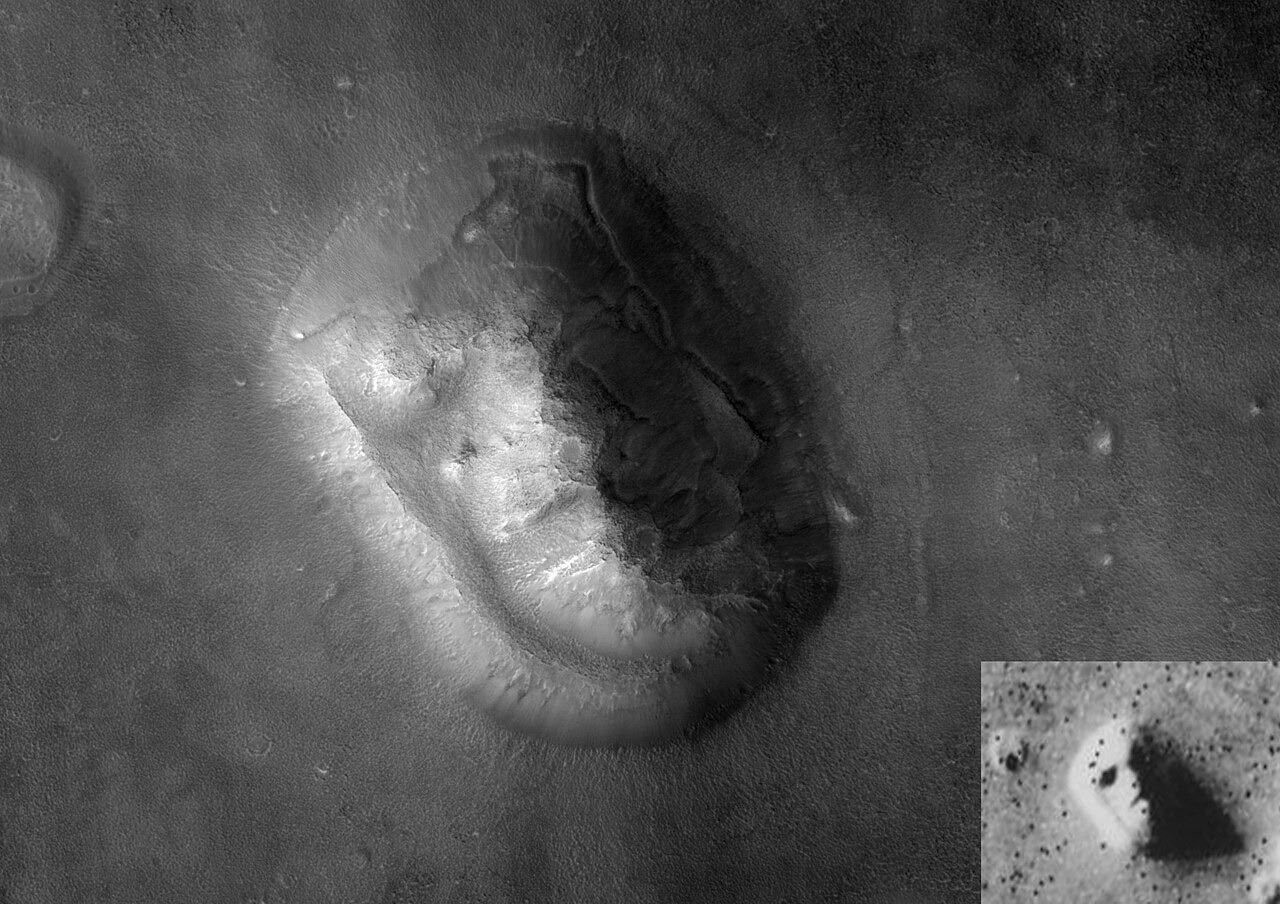
On 25 July 1976 the Viking 1 orbiter photographed a region of Mars called Cydonia. One of the hills in the picture looked like a face, with two eyes, a nose and a mouth. NASA said at the time that shadows produced the effect. A group of researchers and writers argued that the face was a monument, with a ruined city and pyramids beside it, and that NASA did not want to look closely. Spacecraft have since photographed the hill in more than a hundred times the original detail. Scientists say the pictures show a natural landform. Supporters of the monument idea have disputed how the pictures were taken and processed.
The 1976 picture
Viking 1 was looking for a safe place to land its sister craft. The Cydonia picture was taken from 1,873 kilometres away under a low afternoon Sun, and each dot in it covers roughly 45 to 50 metres of ground. The black speckles are missing data. Some of them form part of an “eye” and a “nostril”.
NASA released the picture a few days later. The caption said that the rock formation “resembles a human head” and “is formed by shadows giving the illusion of eyes, nose and mouth”. According to NASA’s own later account, the team published it because they thought it would be a good way to interest the public in Mars.
NASA describes the hill as an eroded mesa. Sources give its width as between 1.5 and 3 kilometres. A NASA scientist who worked with height measurements put it at about 240 metres tall.
How the monument idea grew
Two engineers. A few years later, Vincent DiPietro and Gregory Molenaar, computer engineers working under contract at a NASA centre, found the picture in the archive, along with a second frame taken five weeks after the first under different lighting. They published their analysis in 1982 and also pointed to a five-sided “pyramid” nearby.
The city. The writer Richard Hoagland became the idea’s best-known advocate. In 1987 he published The Monuments of Mars. He described a group of hills near the face as “the City”, with a “fortress” and a “cliff”, and argued that the sites were aligned with where the Sun rose on Mars half a million years ago. Others found mathematical constants in the angles of the “D&M Pyramid”.
The image analyst. Mark Carlotto published a study in the journal Applied Optics in 1988. He built a three-dimensional model from the Viking images and reported that the facial look held up from different viewing angles and lighting directions. He concluded that the features “may not be natural”.
The odds. Tom Van Flandern of the organisation Meta Research calculated in 2000 that the odds against a natural origin were a thousand billion billion to one, and presented the case at a meeting of the American Astronomical Society in 2002.
The cover-up claim
In August 1993 NASA lost contact with its Mars Observer spacecraft three days before it was due to enter orbit. An investigation concluded that the most probable cause was a rupture in the fuel pressurisation side of its propulsion system. Some supporters of the monument idea accused NASA of destroying or hiding the spacecraft to avoid photographing Cydonia. Michael Malin, the scientist in charge of the camera on the next orbiter, answered the accusation of secrecy in 1995: if a picture of the face was taken, he wrote, “it will most definitely be released”.
The later pictures
1998. NASA made Cydonia a priority for its next orbiter, Mars Global Surveyor. “We felt this was important to taxpayers,” said Jim Garvin, chief scientist of NASA’s Mars programme. On 5 April 1998 its camera, built from Mars Observer’s spare parts, photographed the face at 4.3 metres per dot, ten times sharper than Viking. The picture was put on the internet the next day. NASA said it showed a natural landform. It was also taken in winter, through haze.
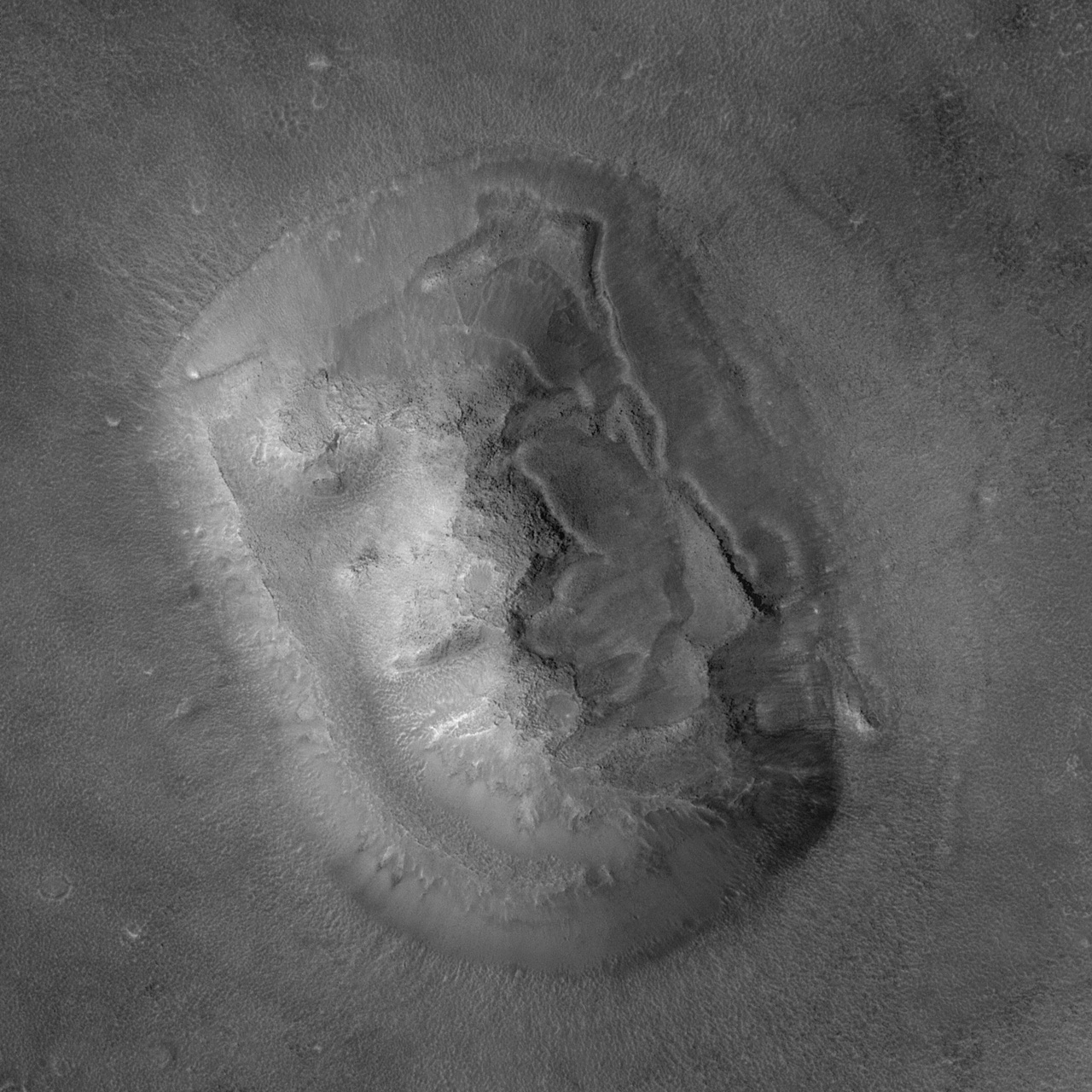
2001. On 8 April 2001 the spacecraft was rolled 25 degrees to photograph the whole mesa on a cloudless summer day, at about 2 metres per dot or better. Garvin said that if there were objects in the picture like “Egyptian-style pyramids or even small shacks, you could see what they were”. A laser instrument also took hundreds of height measurements of the Cydonia mesas, including the face. Its dimensions matched those of the other mesas around it. NASA’s account of the results put it bluntly: “There are no eyes, no nose, and no mouth!”
2006. The European Space Agency’s Mars Express produced three-dimensional views and concluded that “the face remains a figment of human imagination in a heavily eroded surface”.
2007. The HiRISE camera on NASA’s Mars Reconnaissance Orbiter photographed the mesa at about 30 centimetres per dot, sharp enough to show objects less than a metre across.
The arguments, point by point
The face is too regular to be chance
Believers say: two eye sockets, a nose ridge, and a mouth, seen in two separate pictures under different lighting, are too much for coincidence.
The response: Cydonia contains thousands of buttes, mesas and knobs. Scientists say that with so many shapes, some will resemble familiar things, and that the human brain is wired to pick out faces even where there are none. The effect is called pareidolia. Mars also has a crater that looks like a smiley face.
The new pictures were made to look bad
Believers say: the 1998 picture was taken from a poor angle, with the Sun shining from below the “chin”, through cloud, and was then put through filters that flattened the detail. Hoagland compared it to “looking at a TV with a bunch of snow on it”. When the height measurements were published in 2001, he said NASA was relying on data far coarser than the Viking pictures.
The response: the camera team published a description of each processing step, including the filters. The 2001 picture was taken in clear conditions, and the 2006 and 2007 pictures came from different cameras, one of them operated by a different space agency.
It is a ruin
Believers say: by 1993 supporters were arguing that the “pyramids” look irregular because they were damaged long ago.
The response: the European scientists described what the sharp pictures show as landslides and aprons of rubble on a heavily eroded surface, and NASA’s measurements found the mesa to be like its neighbours in every dimension.
The pyramids and the city
Believers say: the nearby hills have straight edges and repeated angles.
The response: wind blowing from one direction over long periods can carve rock into pyramid shapes. NASA said of the D&M Pyramid in 2003 that it “is not really shaped like a pyramid” and is one of thousands of similar landforms. Malin called the measuring of angles “numerology”, and noted that the map of Mars was not accurate enough at the time to support it.

What is still argued about
- How the Cydonia mesas formed. Glaciers, wind, water and movements of the crust have all been proposed. “We simply don’t know,” Garvin said in 2001.
- Whether any picture could settle the matter. On the day the 2001 picture came out, Malin said of the believers: “They can’t be convinced, they don’t want to be convinced.”
In popular culture
The face appeared in tabloids at supermarket checkouts for decades, in an early episode of The X-Files and in the 2000 film Mission to Mars.
Sources
- NASA, “Unmasking the Face on Mars” (24 May 2001), archived copy
- Malin Space Science Systems, “The ‘Face on Mars’” (1995)
- Michael Malin, “Observations of the ‘Face on Mars’ and similar features by the Mars Global Surveyor Orbiter Camera” (1995)
- NASA Photojournal, “Geologic ‘Face on Mars’ Formation”
- NASA Photojournal, “Mars Orbiter Camera Views the ‘Face on Mars’ - Comparison with Viking” (1998)
- NASA Photojournal, “Highest-Resolution View of ‘Face on Mars’” (2001)
- European Space Agency, “Cydonia - the face on Mars” (2006)
- HiRISE, University of Arizona, “Popular Landform in Cydonia Region” (2007)
- NASA Photojournal, “The Cydonia ‘D&M Pyramid’ Landform” (2003)
- Astronomical Society of the Pacific, “The Face on Mars”, The Universe in the Classroom (1993)
- NASA, Mars Observer mission advisories (August 1993)
- Malin Space Science Systems, “The Loss of Mars Observer” (1995)
- Science Frontiers, “It Depends on How you Look at It!” (2000)
- New England Skeptical Society, “About Face for Mars”
- Phil Plait, Bad Astronomy, “Face to Face”
- Tom Van Flandern, “Artificial structures on Mars”, abstract, American Astronomical Society (2002)
- Associated Press via The Herald, “NASA says ‘Face on Mars’ is just a hill” (2001)
- Scientific American, “The ‘Face on Mars’ and Other Cases of Cosmic Pareidolia” (2024)
- Science Frontiers, “A New Face on Mars?” (1988)
- David Darling, Encyclopedia of Science, “‘face’ on Mars”
- Encyclopedia.com, “Mars, Face on”
- Gary Posner, “The Face Behind the ‘Face’ on Mars”, Skeptical Inquirer (2000), author’s copy
- Mark Carlotto, “Digital Imagery Analysis of Unusual Martian Surface Features”, Applied Optics (1988)
- Richard Hoagland, The Monuments of Mars: A City on the Edge of Forever (1987)