
The short version
Flat-Earth believers hold that the world is a disc or plane, not a spinning globe, and that space agencies and governments are hiding it. Scientists regard the question as settled since antiquity. The modern movement is small, but it grew quickly on YouTube from about 2014 and has become the best-known example of people rejecting an entire field of knowledge.
What the theory says
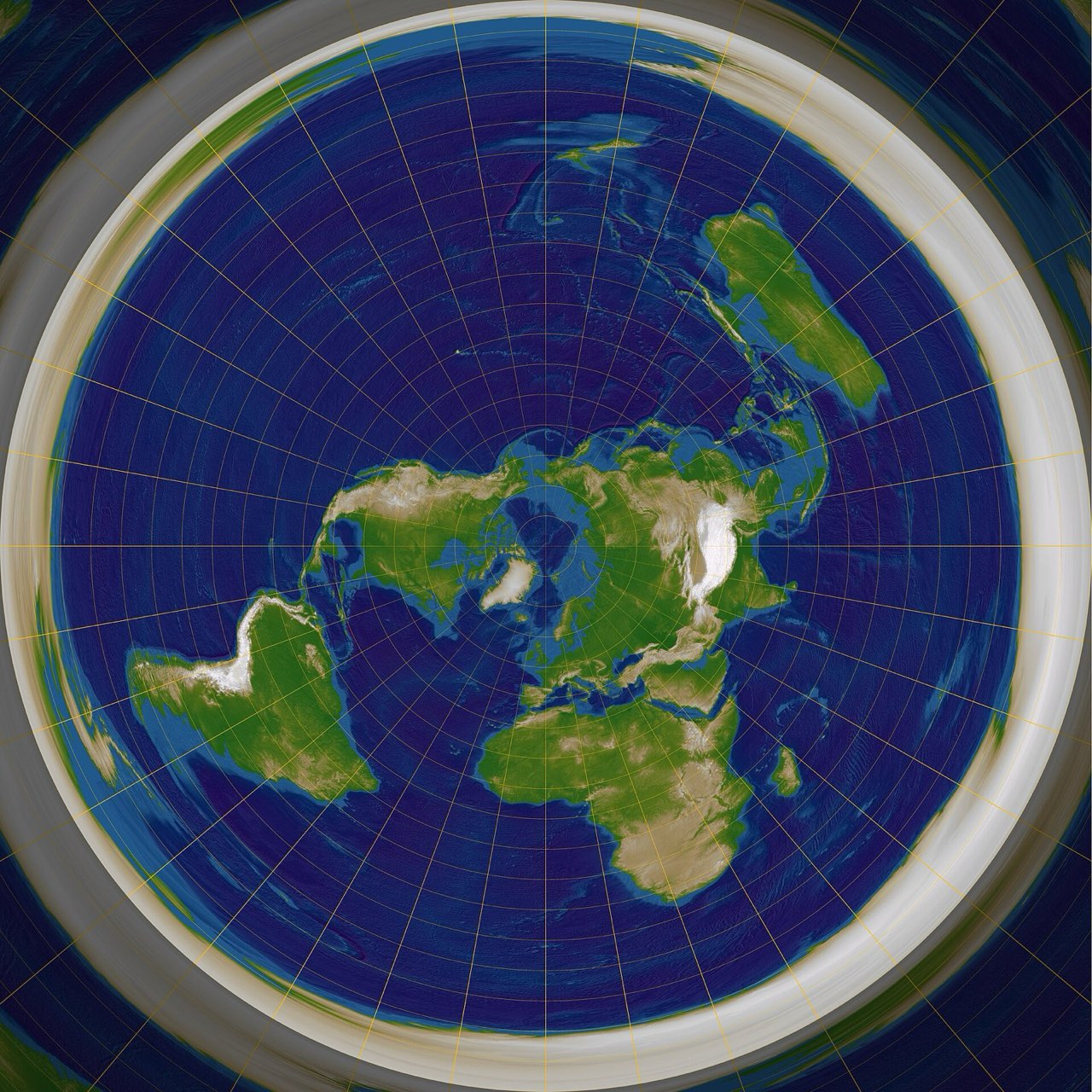
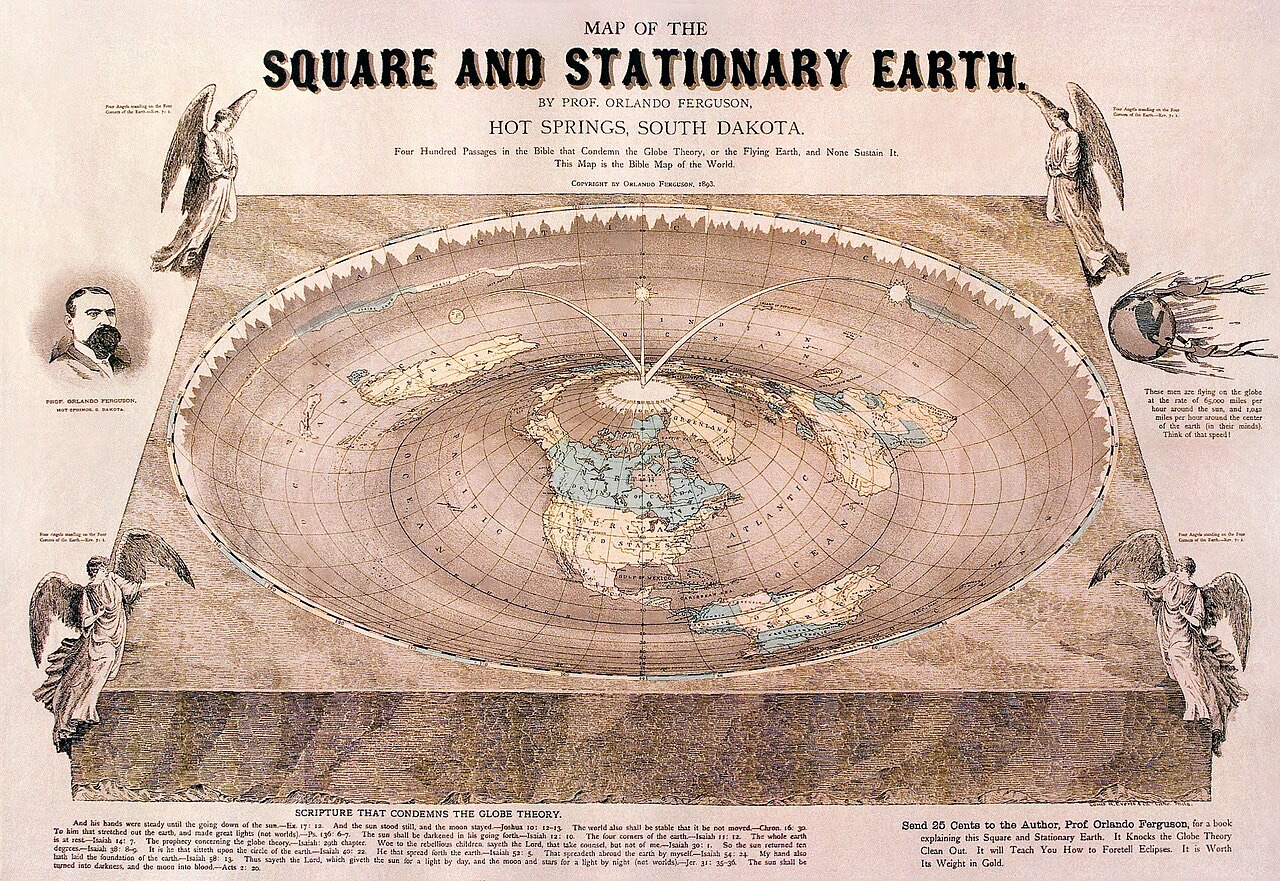
In the most common version, the Earth is a flat disc with the North Pole at the centre. Antarctica is not a continent but a wall of ice around the rim that holds the oceans in. The Sun and Moon are small and close, and circle above the disc like spotlights, which is said to explain day and night. Some add a solid dome overhead. Gravity is replaced by other explanations, such as objects simply being denser than air.
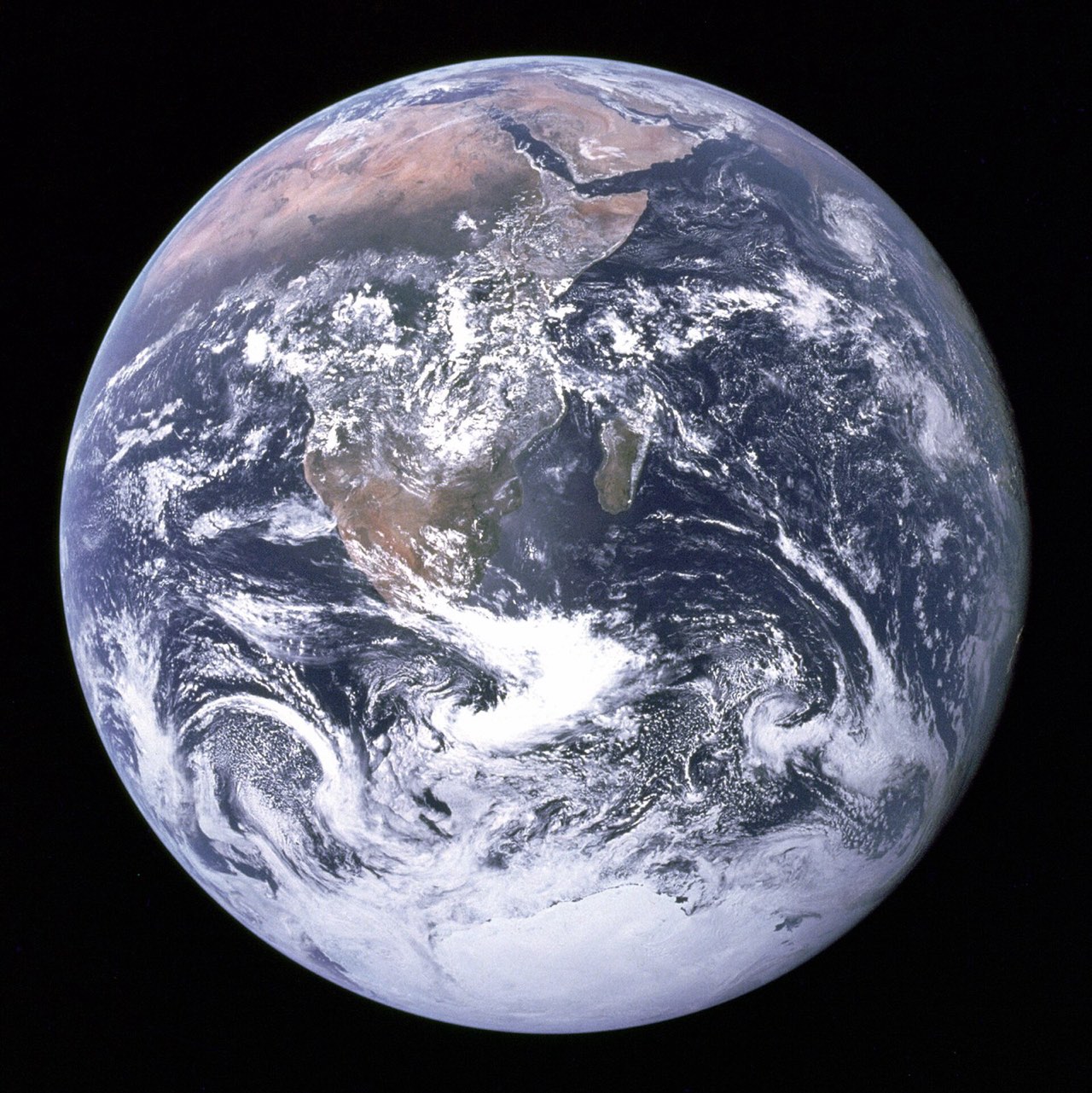
Because photographs from space show a globe, the theory requires that those images are fabricated and that every space agency, airline and navy is either fooled or involved.
Where it came from
Educated people have known the Earth is round since ancient Greece. Around 240 BC, Eratosthenes estimated its circumference from the different lengths of shadows in two Egyptian cities. The idea that medieval Europeans believed in a flat Earth is largely a 19th-century myth.
Modern flat-Earth belief began in England in the mid-1800s with Samuel Rowbotham, who wrote under the name “Parallax”. He claimed that an experiment along a long, straight canal showed no curvature. In 1870 the naturalist Alfred Russel Wallace repeated the test, accounting for the bending of light near the water, and found the curve.
The Flat Earth Society was founded in 1956. The current wave started with YouTube series in 2014 and 2015, followed by conferences and the 2018 documentary Behind the Curve.
Versions of the theory
The disc with an ice wall. The classic model described above.
The dome. A flat Earth covered by a firmament, often drawn from a literal reading of scripture.
The infinite plane. The known continents are a small part of a much larger flat surface beyond the ice.
“Not a globe.” Some decline to give a model at all and argue only that the official one is unproven.

The arguments, point by point
The horizon looks flat
Believers say: from a beach or an airliner the horizon is a straight line at eye level.
The response: the Earth is about 40,000 km around, so the curve is too slight to see from low altitude. It becomes visible from very high balloons and from orbit.
Water always finds its level
Believers say: water cannot stick to the outside of a spinning ball.
The response: “level” means at right angles to the pull of gravity, which points to the centre of the Earth. The surface of an ocean follows that curve.
We cannot feel the Earth move
Believers say: a planet spinning at 1,600 km/h would throw us off or at least be noticeable.
The response: we feel changes in speed, not steady motion, which is why a smooth flight feels still. One turn every 24 hours is very slow rotation.
Distant objects can be seen that should be hidden
Believers say: photographs show skylines and mountains from distances at which a globe would hide them.
The response: air bends light, especially over water, which lets observers see somewhat beyond the geometric horizon. The amount varies with temperature. The bottom of the distant object is still cut off.
Images from space are faked
Believers say: NASA admits some pictures of Earth are composites.
The response: some are stitched together from many satellite passes, and are labelled as such. Others are single photographs, including those taken by Apollo crews and by spacecraft from Japan, India, China, Russia and Europe.
What the evidence shows
- Ships and shorelines disappear from the bottom up as they move away.
- The night sky differs by latitude. People in Australia see stars that are never visible from Europe, and they circle a different point in the sky.
- Lunar eclipses always show a round shadow of the Earth on the Moon.
- Time zones exist because the Sun rises in one place while it sets in another.
- Flights in the southern hemisphere, such as Sydney to Santiago, take a time that matches a globe and would be impossibly long on the disc map.
- Antarctica has continuous daylight in its summer, which the disc model cannot produce.

When believers ran the tests
In Behind the Curve, a group of flat-Earthers bought a precision gyroscope to show that the Earth does not rotate. It registered a drift of 15 degrees per hour, the figure expected for a globe turning once a day. A second experiment, shining a light through holes at equal heights, also gave the globe result.
In December 2024 a pastor from Colorado organised “The Final Experiment”, flying flat-Earth and globe advocates to Antarctica to see whether the Sun stayed up for 24 hours. It did. One prominent flat-Earth YouTuber on the trip said publicly that he had been wrong about that point. Others said the trip was staged.
How many people believe it
Firm belief is rare. A 2018 YouGov survey of more than 8,000 American adults found that 84% had always believed the world is round and 2% said it is flat, with more doubt among the youngest adults. A 2019 YouGov poll in Britain found 1% calling a flat Earth definitely true and 2% probably true.
Why it persists
Researchers who study the movement describe it less as a claim about geography than as distrust of institutions. If the shape of the world can be faked, nothing official can be believed. Many followers arrive from other conspiracy theories, and the community offers belonging to people who feel dismissed.
Sources
- YouGov, “Most flat earthers consider themselves very religious” (2018)
- Scientific American, “Flat-Earthery, British Style” (2019 UK poll)
- Scientific American, “Do People Really Think Earth Might Be Flat?”
- IFLScience, “Flat-Earthers Travel To Antarctica To Test Theories, But Are Quickly Humbled” (December 2024)
- Behind the Curve (documentary, 2018)
- Christine Garwood, Flat Earth: The History of an Infamous Idea (2007)