
The short version
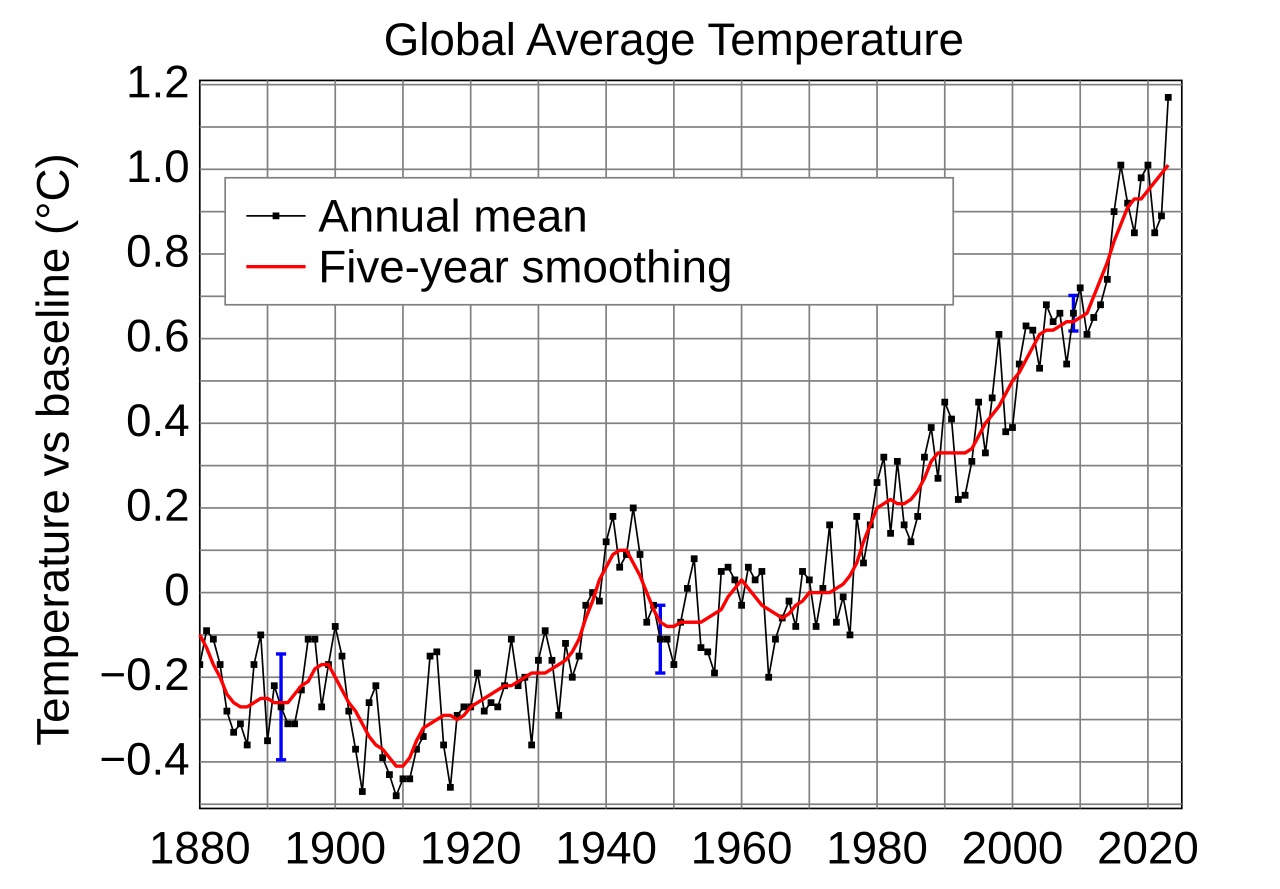
The Intergovernmental Panel on Climate Change (IPCC), the UN body that assesses climate research, says human activities have “unequivocally caused global warming”. Temperature records from NASA and Europe’s Copernicus service show the last few years as the hottest on record. Some prominent figures reject this. In 2003 the US senator James Inhofe asked whether manmade global warming was “the greatest hoax ever perpetrated on the American people”, and in 2025 President Donald Trump told the United Nations that climate change was “the greatest con job ever perpetrated on the world”. Those who doubt the mainstream view point to hacked scientists’ emails, disputed temperature reconstructions, computer models they say run too hot, and the cost of climate policies. Scientists and official inquiries have responded to these points.
What the scientific bodies say
The IPCC’s 2023 synthesis report states: “Human activities, principally through emissions of greenhouse gases, have unequivocally caused global warming, with global surface temperature reaching 1.1°C above 1850-1900 in 2011-2020.”
According to Copernicus, the EU’s climate service, 2024 was the warmest year on record and the first calendar year more than 1.5 °C above pre-industrial levels. Copernicus ranked 2025 third, while NASA found it effectively tied with 2023 for second. In early November 2026 Copernicus said 2026 was virtually certain to exceed 1.5 °C as well. The concentration of carbon dioxide measured at NOAA’s Mauna Loa Observatory in Hawaii reached 426.69 parts per million in October 2026, up from 424.87 a year earlier.
Studies of the scientific literature have found broad agreement. A 2013 study by John Cook and colleagues found that 97.1% of research abstracts that took a position endorsed human-caused warming, although two-thirds took no position. A 2021 study by Mark Lynas and colleagues put the figure at more than 99%. Critics, among them the economist Richard Tol, have come to different conclusions about the size of the consensus.
The case made by the doubters
“A hoax”
In a Senate speech in July 2003, Inhofe, then chairman of the Senate Environment and Public Works Committee, said: “could it be that manmade global warming is the greatest hoax ever perpetrated on the American people? I believe it is.” He argued that the motives for the Kyoto climate treaty were “economic, not environmental”. In February 2015 he brought a snowball onto the Senate floor, in response to reports that 2014 had been the warmest year on record. “It’s a snowball, and that’s just from outside here, so it’s very, very cold out, very unseasonable,” he said.
In 2012 Donald Trump tweeted: “The concept of global warming was created by and for the Chinese in order to make U.S. manufacturing non-competitive.” He later said it was a joke. At the UN General Assembly in September 2025 he said: “This ‘climate change,’ it’s the greatest con job ever perpetrated on the world, in my opinion.”
Climategate
In 2009, shortly before a UN climate summit in Copenhagen, emails from the Climatic Research Unit at the University of East Anglia were hacked and published. Critics pointed to phrases such as a “trick” to “hide the decline” as evidence that scientists were manipulating data.
The response: scientists said the phrase concerned tree-ring data that stopped matching measured temperatures after the 1960s, not a decline in actual temperatures. According to Scientific American, eight inquiries in the UK and the US cleared the scientists of wrongdoing. One of them, led by Sir Muir Russell, found that their honesty as scientists was not in doubt, but criticised a failure to be properly open.
The hockey stick
A temperature reconstruction published in 1998 and 1999 by the climate scientist Michael Mann and colleagues produced a graph that became known as the “hockey stick”. Critics, including the Canadian researchers Steve McIntyre and Ross McKitrick, challenged the statistical methods.
The response: a 2006 review by the US National Research Council found the main conclusion plausible and had high confidence that the late 20th century was warmer than any comparable period in the previous 400 years, though less confidence in earlier centuries. A 2019 study of the past 2,000 years found that the 20th century was likely the warmest for over 98% of the globe.
The Sun and natural cycles
Doubters say: the climate has always changed, and the Sun or natural cycles may explain the warming.
The response: NASA says the energy reaching the Earth from the Sun has shown no net increase since the 1950s, and that the upper atmosphere has cooled while the surface warmed, a pattern it attributes to greenhouse gases rather than the Sun.
The models
Doubters say: climate models exaggerate future warming.
The response: some mainstream scientists agree that a subset of the newest models is too sensitive, and the IPCC’s latest report did not rely on a simple average of them. A 2019 study found that 14 of 17 models published between the early 1970s and late 2000s had projected warming quite accurately.
The cost
Doubters say: climate policies are expensive and their benefits are overstated. A 2025 report for the US Department of Energy, written by five scientists including John Christy, Judith Curry and Steven Koonin, argued that warming caused by carbon dioxide appears less damaging economically than commonly believed. The Energy Secretary, Chris Wright, said: “Climate change is real, and it deserves attention. But it is not the greatest threat facing humanity.”
The response: other climate scientists criticised the report sharply, while the Department of Energy said its authors represented diverse viewpoints. Separately, in September 2025 the US National Academies of Sciences said the evidence that greenhouse gases harm Americans’ health and welfare is beyond scientific dispute.
What the oil industry knew
A 2023 study in Science by Geoffrey Supran, Stefan Rahmstorf and Naomi Oreskes found that most of the global warming projections made by ExxonMobil’s own scientists between 1977 and 2003 were accurate, while the company’s public messages emphasised doubt. ExxonMobil says that those who claim “Exxon knew” are wrong in their conclusions. The study was partly funded by a foundation that supports lawsuits against the company.
Policy in the United States
In January 2025 President Trump ordered the US to withdraw from the Paris climate agreement, and the withdrawal took effect in January 2026. In February 2026 the Environmental Protection Agency repealed its 2009 finding that greenhouse gases endanger public health and welfare, the legal basis for many US climate rules. The EPA says the repeal will save more than $1.3 trillion. Health and environmental groups sued, and as of November 2026 no ruling had been reported.


What people think
In the Yale Program on Climate Change Communication’s autumn 2025 survey, 72% of Americans said global warming is happening and 13% said it is not. In a Pew Research Center survey in March 2026, 48% of Americans said the Earth is warming mostly because of human activity, 22% said natural patterns, 12% said there is no solid evidence of warming, and 17% were not sure. In an international YouGov survey in 2019, 17% of Americans agreed that manmade global warming is a hoax invented to deceive people.
What is still argued about
- How fast the warming will continue and how much damage it will do.
- How much should be spent to limit it, and by whom.
- Whether the scientific consensus is as strong as its supporters say.
Sources
- IPCC, “Climate Change 2023: Synthesis Report, Summary for Policymakers”
- Copernicus Climate Change Service, “Global Climate Highlights 2024” (2025)
- Copernicus, “2025 was the third hottest year on record” (2026)
- NASA, “NASA Releases Global Temperature Data” (2026)
- Copernicus, “Warmest October on record with 2026 virtually certain to exceed 1.5°C” (2026)
- NOAA Global Monitoring Laboratory, “Trends in Atmospheric Carbon Dioxide – Mauna Loa”
- National Academies, report on greenhouse gas emissions and US climate, health and welfare (2025)
- Cook et al., “Quantifying the consensus on anthropogenic global warming in the scientific literature”, Environmental Research Letters (2013)
- Lynas, Houlton and Perry, “Greater than 99% consensus on human caused climate change in the peer-reviewed scientific literature”, Environmental Research Letters (2021)
- Cook et al., “Consensus on consensus”, Environmental Research Letters (2016)
- Congressional Record, James Inhofe, “Science of Climate Change” (2003)
- Time, “Senator Throws Snowball! Climate Change Disproven!” (2015)
- PolitiFact, “Yes, Donald Trump did call climate change a Chinese hoax” (2016)
- PBS NewsHour (AP), “Trump called climate change a ‘con job’ at the United Nations. Here are the facts and context” (2025)
- Scientific American, “U.K. Police Close Climategate Inquiry” (2012)
- Channel 4 News, “Climategate: the emails behind a scientific storm” (2010)
- Physics Today, “Climategate review clears scientists of dishonesty” (2010)
- National Academies, “High Confidence That Planet Is Warmest in 400 Years” (2006)
- University of Bern, “The climate is warming faster than it has in the last 2,000 years” (2019)
- NASA, “Is the Sun causing global warming?”
- Carbon Brief, “How climate scientists should handle ‘hot models’” (2022)
- UC Berkeley News, “Early climate modelers got global warming right, new report finds” (2019)
- US Department of Energy, report on the impact of greenhouse gases on the US climate (2025)
- Inside Climate News, “Climate Scientists Look to Fight Back Against DOE’s Climate Report” (2025)
- Potsdam Institute for Climate Impact Research, press release on what Exxon knew (2023)
- Inside Climate News, “Exxon Accurately Predicted Global Warming, Years Before Casting Doubt on Climate Science” (2023)
- Harvard Environmental and Energy Law Program, “Paris Climate Agreement” tracker
- US EPA, on the repeal of the endangerment finding (2026)
- PBS NewsHour (AP), “Groups sue Trump’s EPA over repeal of rule that supported climate protections” (2026)
- Yale Program on Climate Change Communication, “Climate Change in the American Mind: Beliefs & Attitudes, Fall 2025”
- Pew Research Center, “Americans on what causes climate change: Human activity or natural patterns?” (2026)
- weather.com, “America Leads Western Nations in Denying Climate Change, According to Poll” (2019)