
The short version
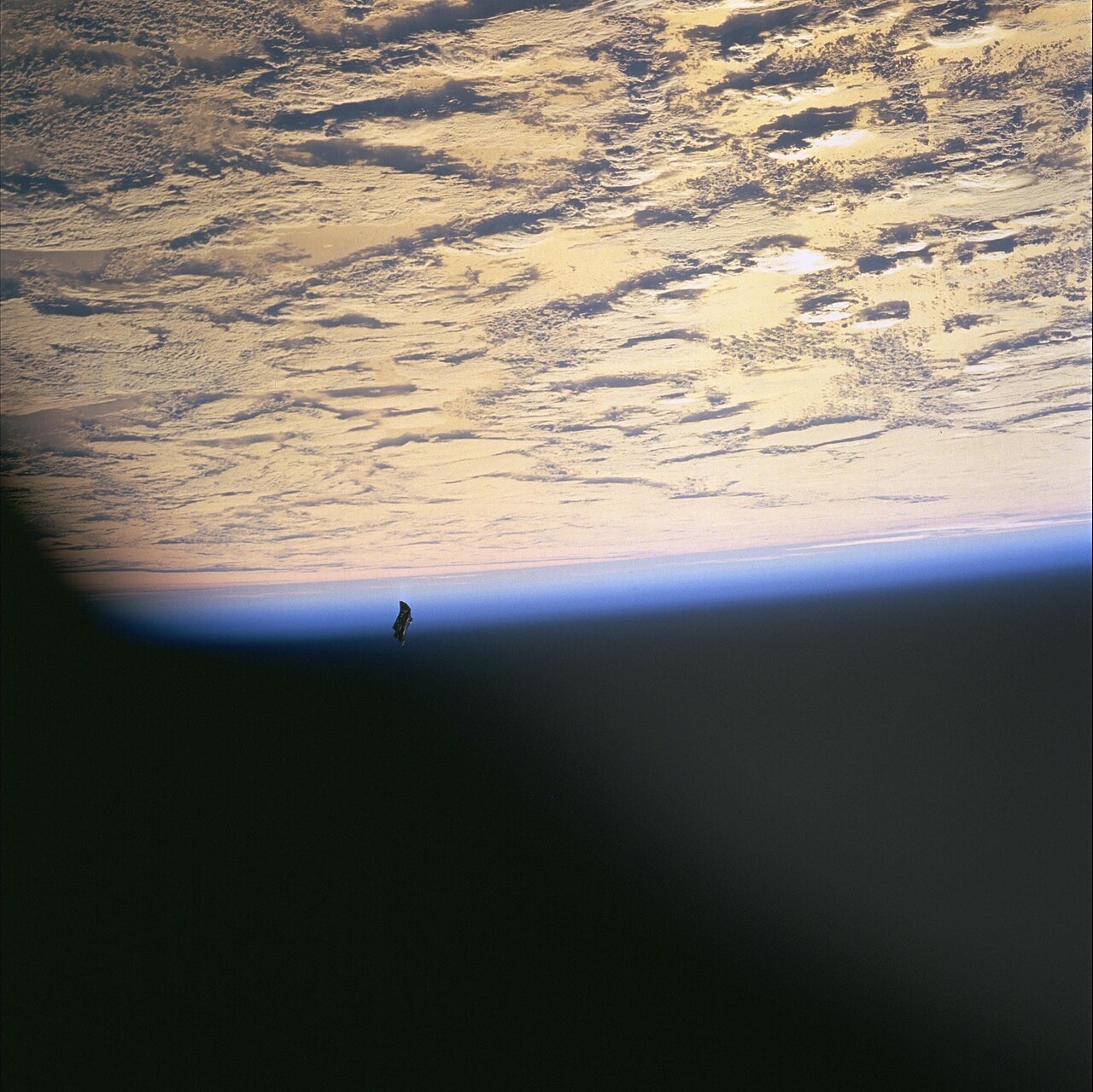
The Black Knight theory says that an artificial object, possibly built by aliens, has been circling the Earth over the poles for about 13,000 years, and that NASA and the US government know it. Its best-known evidence is a set of photographs taken from the space shuttle Endeavour in 1998. Sceptics describe the legend as a patchwork: unrelated events from 1899, 1927, 1954, 1960, 1963 and 1998 that were stitched together afterwards. Nobody has been able to establish who first gave the supposed satellite its name, or when.
The pieces of the story
1899: Tesla’s signals
The inventor Nikola Tesla went to Colorado in 1899 to carry out experiments. In a magazine article two years later he described picking up electrical changes that came “periodically, and with such a clear suggestion of number and order” that he could not trace them to any known cause. He came to feel that he had been “the first to hear the greeting of one planet to another”.
In the legend: Tesla heard the Black Knight.
The record: Tesla wrote of a greeting from another planet, and the magazine’s editors suggested Mars or Venus. He never spoke of an object orbiting the Earth. What he detected is not agreed. A NASA scientist quoted by Space.com says that if the signal was real, it most likely came from the Earth.
1927: echoes from nowhere
Jørgen Hals, a Norwegian engineer and radio amateur, noticed that signals from a Dutch short-wave station were followed by an echo about three seconds later. The physicist Carl Størmer published the finding in Nature in 1928 and reproduced it in experiments. These “long delayed echoes” have been reported with delays from 3 to 30 seconds.
In 1973 the Scottish writer Duncan Lunan proposed in the magazine Spaceflight that the echoes had been sent back by an alien probe. He plotted the delays as a chart and read it as a map of the constellation Boötes as it looked thousands of years ago, pointing to the star Epsilon Boötis. Accounts of his figure range from 12,600 to 15,000 years.
In the legend: this is where the age of 13,000 years comes from.
The record: Lunan placed his probe near the Moon, not in polar orbit, and never used the name Black Knight. He withdrew his translation in 1976 and has called the connection to the Black Knight “nonsense”. He still holds that the echoes have no satisfactory natural explanation. Researchers’ leading ideas involve the upper atmosphere and the Earth’s magnetic field, but the cause of the echoes remains unknown.
1954: satellites before Sputnik
In May 1954, three years before the first artificial satellite was launched, American newspapers reported a claim by the UFO author Donald Keyhoe that the US Air Force had detected at least two satellites orbiting the Earth.
The record: Keyhoe was promoting a book. Later that year the objects were reported to have been identified as natural bodies. The claim of artificial satellites has never been substantiated.
1960: the dark satellite
In February 1960, headlines announced that the United States had detected a mysterious “dark” satellite. A US Navy radar system had picked up an unknown object in a roughly polar orbit, and there was speculation that it was Soviet.
In the legend: the dark satellite was the Black Knight.
The record: within weeks the Department of Defense identified it. Time magazine reported in March 1960 that it was “a space derelict, the remains of an Air Force Discoverer satellite that had gone astray”. Accounts differ on which Discoverer flight it came from. The Discoverer programme was itself a cover story for the Corona spy satellites, which photographed the Soviet Union.
1963: the astronaut
The story says that astronaut Gordon Cooper saw a glowing green object during his Mercury flight in May 1963, and that a tracking station in Australia saw it on radar.
The record: there is nothing about such an object in the mission audio or transcripts. Cooper, who did say he had seen UFOs at other times in his career, denied seeing anything on that flight.
1998: the photographs
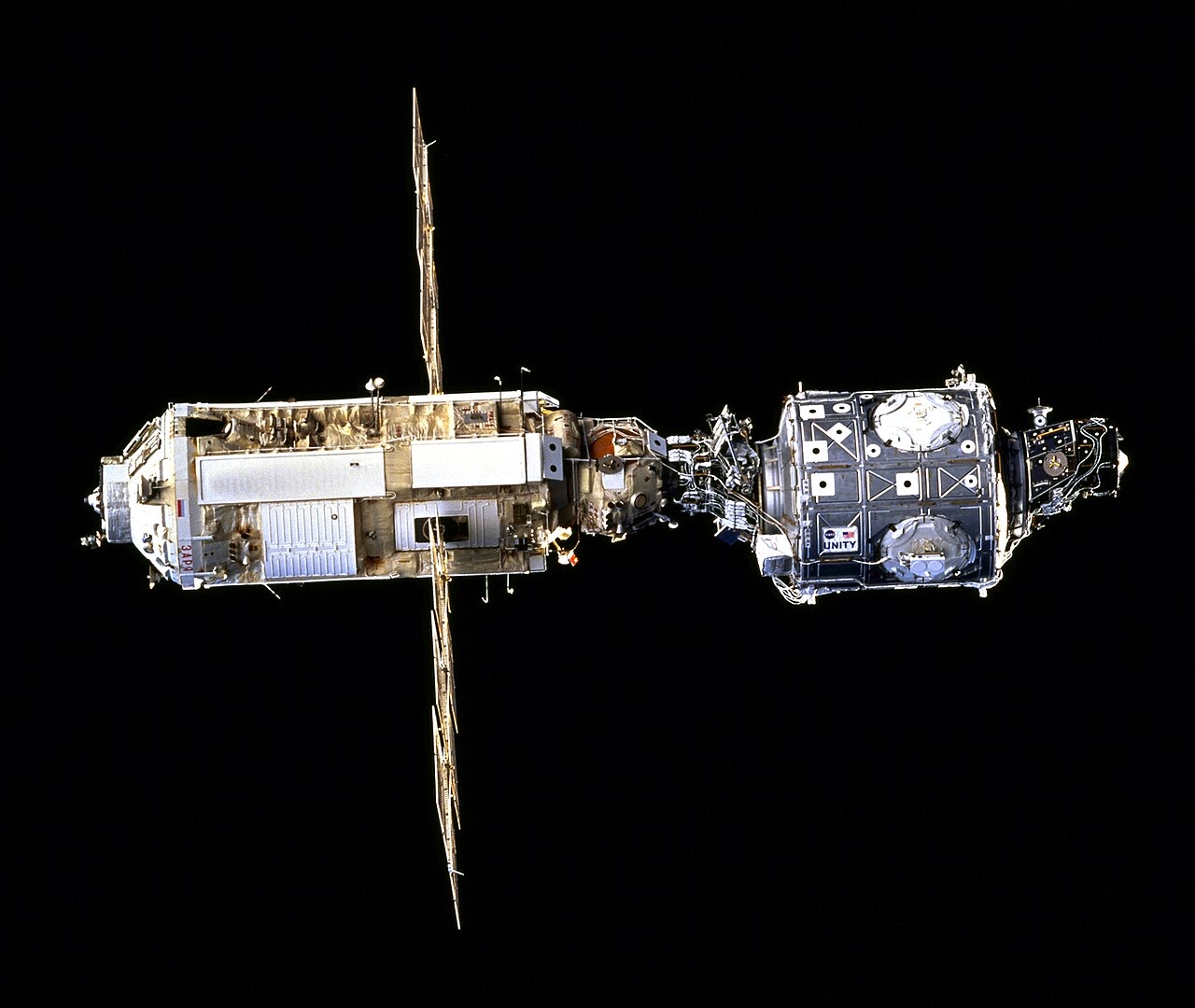
In December 1998 the shuttle Endeavour flew the first assembly mission for the International Space Station, joining the American module Unity to the Russian module Zarya. The crew photographed a dark, irregular object drifting against the Earth below. The pictures are in NASA’s public archive, where the object is labelled as space debris.
In the legend: this is the Black Knight itself, caught on camera at last.
NASA’s account: during a spacewalk, astronaut Jerry Ross was fitting insulating covers over four metal pins on Unity when one cover came loose and floated off. The commander radioed: “Jerry, one of the thermal covers got away from you.” NASA’s mission summary lists the cover among the items lost. It was tracked as object 25570, and it fell out of orbit and burned up about a week later.
The arguments, point by point
The object does not look like a blanket
Believers say: the photographs are undeniable proof. A blanket could not change shape in space, where there is no wind. Video of the lost cover shows something white, not black.
The response: James Oberg, a former NASA engineer who led the team that planned the mission’s flight path, analysed the pictures and the cabin video in 2014. He says the stills are close-ups of the same object seen drifting away in the video. The cover was silver on one side and white on the other, and its reflective side looks black when it mirrors space.
NASA hid the pictures
Believers say: the photographs disappeared from NASA’s website.
The response: NASA reorganised its online archive, and the old links stopped working. The photographs are still published by NASA.
The orbit
Believers say: the object is in polar orbit, as reported in 1960.
The response: the shuttle was not. It flew the space station’s orbit, tilted 51.6 degrees to the equator. An object that drifts slowly beside the shuttle shares its orbit. A satellite crossing over the poles would have flashed past at enormous speed.
Too many coincidences
Believers say: strange signals, strange echoes and strange objects have kept turning up for more than a century.
The response: sceptics answer that none of the original reports used the name Black Knight, and that the episodes were connected only afterwards. Asked about the theory, Jerry Ross said that astronauts would be “the first ones to ask questions” if they saw something they did not understand.
The other Black Knight
There was a real Black Knight. It was a British research rocket, launched 22 times from Woomera in Australia between 1958 and 1965 to test a re-entry vehicle for a British missile. It never put anything into orbit. Whether the legend borrowed its name from the rocket is not known.
What is still argued about
- What Tesla detected in 1899.
- What causes long delayed echoes. Almost a century after Hals heard them, there is no confirmed explanation.
- Who joined these episodes into one story, and when.

Sources
- Space.com, “The ‘Black Knight’ satellite: A 120-year-old conspiracy theory” (updated 2025)
- Space.com, “Could there be an ancient alien satellite in Earth’s orbit? How the ‘Black Knight’ conspiracy theory has survived for over 100 years” (2026)
- Armagh Observatory and Planetarium, “The Truth About the Black Knight Satellite Mystery” (2013)
- Nikola Tesla, “Talking with the Planets”, Collier’s Weekly (9 February 1901), transcription
- Sverre Holm, University of Oslo, “The Five Most Likely Explanations for Long Delayed Echoes”
- Space.com, “What causes mysterious long delayed radio echoes in Earth’s atmosphere?” (2026)
- Time, “Science: Space Watch’s First Catch” (7 March 1960)
- NASA, “STS-88” mission page
- NASA Johnson Space Center, astronaut photograph STS088-724-66
- Live Science, “The Black Knight Satellite: A Hodgepodge of Alien Conspiracy Theories” (2019)
- Science Museum Group, “Black Knight ballistic test vehicle, wind tunnel model, ca. 1960”
- James Oberg, “Phantom satellite? What IS it? What ISN’T it? WHY the confusion?” (2014), archived copy
- Skeptoid, “The Black Knight Satellite” (2013)